Agile vs Scrum
-
 Sanplex Content
 -
 2021-03-10 14:24:00
 -
 0
0
Waterfall project management is a well-known method in software development, and its basic process is requirements -> development -> testing. It assumes that the final result will be correct if each phase is completed successfully. Microsoft has historically used the Waterfall method with good results.
However, it has a relatively high failure rate because market demands and requirements are constantly changing. Software pioneers conducted extensive research, reflection, and analysis on the problems found in the Waterfall methodology and eventually came up with the concept of Agile.
What is Agile?
Agile is an approach that helps teams iterate on processes in the Software Development Life Cycle (SDLC), such as development, testing, and so on. This technique has advantages, including the ability to produce high-value functionality in short implementation times, which was previously a problem with the traditional Waterfall approach. It also helps to enhance customer retention and satisfaction. This is accomplished by breaking down the product into smaller units/builds, allowing operations to run concurrently or iteratively. Agile encourages collaboration and face-to-face communication.
The Agile Manifesto was released in 2001 by 17 independent-minded software practitioners. While the participants didn't always agree, they did find consensus around four core values:
- Individuals and interactions over processes and tools
- Working software over comprehensive documentation
- Customer collaboration over contract negotiation
- Responding to change over following a plan
Agile approaches include:
- Scrum
- Kanban
- Feature Driven Development (FDD)
- Extreme Programming (XP)
- Lean Software Development (LSD)
- Adaptive System Development (ASD)
- Dynamic Systems Development Method (DSDM)
What is Scrum?
Scrum is a simple and lightweight framework that aids individuals, teams, and organizations in creating value by allowing them to respond to complex problems.
Scrum requires a Scrum Master to foster an environment where:
- A Product Owner orders the work for a complex problem into a Product Backlog.
- The Scrum Team turns a selection of the work into an Increment of value during a Sprint.
- The Scrum Team and its stakeholders inspect the results and adjust for the next Sprint.
- Repeat.
Scrum can be understood in the 3-5-3 structure:
- 3 Roles: Product Owner, Scrum Master, and the Team.
- 5 Events: Sprint, Sprint Planning, Daily Scrum, Sprint Review, and Sprint Retrospective.
- 3 Artifacts: Product Backlog, Sprint Backlog, and Increment.
Agile vs. Scrum
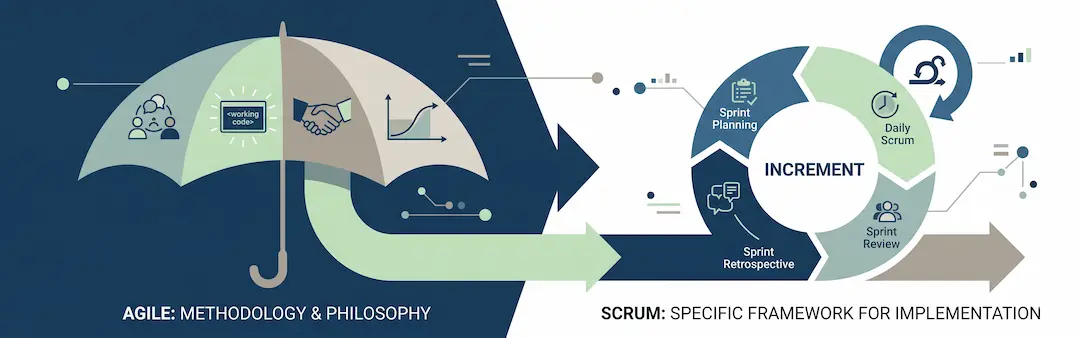
The primary difference between Agile and Scrum is that, while Agile is a project management framework based on a core collection of standards or concepts, Scrum is a specialized Agile approach for project management.
| Agile | Scrum |
| Agile is a broader methodology/philosophy. |
Scrum is a specific framework used to implement Agile. |
| Leadership plays a significant role in Agile. |
Scrum utilizes cross-functional and self-organizing teams. |
| Favors simple design and execution. |
Encourages innovative and creative design and execution. |
| Tasks are often managed by a project leader (in hybrid setups). |
Issues and tasks are addressed by the entire Scrum team. |
| Customer satisfaction is the top priority. |
Delivering the maximum business value is the primary focus. |
| Face-to-face communication and in-person interactions are emphasized. |
Daily Scrum meetings specifically define and track the responsibilities of Scrum roles. |