
DevOps and Agile: What is the Difference?
-
 Sanplex Content
 -
 2021-03-18 14:52:40
 -
 3582
3582
In the early days, there was no specific management process for software development. Then came the Waterfall development process, which proposed that software development activities could be defined by the time spent developing and building applications.
At that time, because there were no review cycles or trade-off considerations in the development process, it often took a long time to develop, test, and deploy software. The delivered software was often of poor quality, riddled with defects and bugs, and the delivery time rarely met the initial requirements. The focus of software project management back then was entirely on long-term, protracted plans.
The Waterfall process is related to the triple constraint model, also called the project management triangle. Each side of the triangle represents one of the three core elements of project management: scope, time, and cost. As Angelo Baretta writes, the triple constraint model "posits that cost is a function of time and scope. These three constraints interact in a definite and predictable way... If we want to shorten the timetable (time), we must increase the cost. If we want to increase the scope, we must increase the cost or time."
The Transition from Waterfall to Agile Development
The Waterfall process originates from the manufacturing and engineering fields, which are suited for highly linear processes—just as a supporting wall needs to be built before the roof of a house. Similarly, it was believed that software development problems could be solved by exhaustive upfront planning. From beginning to end, the development process was clearly defined by a roadmap, under the assumption that the final product would perfectly align with that roadmap.
Ultimately, the Waterfall model proved to be unfavorable and counterintuitive for software development. The value of the project is usually not realized until the very end of the development process, leading to the eventual failure of many projects. Moreover, the client cannot see any working software until the project concludes.
Agile uses a fundamentally different approach. It abandons the idea of rigidly planning the entire project upfront. Instead of promising an estimated completion point and blindly following a static plan, Agile assumes and embraces uncertainty. Its philosophy is to respond to changes instead of rigidly adhering to past discussions, recognizing that changing requirements are a natural part of customer needs.
Agile Values
Agile is endorsed by the Agile Manifesto, which outlines 12 core principles:
- Our highest priority is to satisfy the customer through early and continuous delivery of valuable software.
- Welcome changing requirements, even late in development. Agile processes harness change for the customer's competitive advantage.
- Deliver working software frequently, from a couple of weeks to a couple of months, with a preference for the shorter timescale.
- Business people and developers must work together daily throughout the project.
- Build projects around motivated individuals. Give them the environment and support they need, and trust them to get the job done.
- The most efficient and effective method of conveying information is face-to-face conversation.
- Working software is the primary measure of progress.
- Agile processes promote sustainable development. The sponsors, developers, and users should be able to maintain a constant pace indefinitely.
- Continuous attention to technical excellence and good design enhances agility.
- Simplicity—the art of maximizing the amount of work not done—is essential.
- The best architectures, requirements, and designs emerge from self-organizing teams.
- At regular intervals, the team reflects on how to become more effective, then tunes and adjusts its behavior accordingly.
The four core values of Agile are:
- Individuals and interactions over processes and tools.
- Working software over comprehensive documentation.
- Customer collaboration over contract negotiation.
- Responding to change over following a plan.
This is the exact opposite of the rigid planning style of the Waterfall process. In an Agile process, the customer acts as a member of the development team, keeping continuous input throughout the process rather than just defining project requirements at the start and accepting the product at the end. Furthermore, Agile requires continuous improvement across the organization. The development team collaborates with other units, including project management and testing teams.
Agile Software Development
Agile software development requires adaptive planning, evolutionary development, and continuous delivery. Many software development methods, frameworks, and practices follow the Agile philosophy, including:
- Scrum
- Kanban (Visual workflow)
- Extreme Programming (XP)
- Lean Methodology
- Feature-Driven Development (FDD)
- Test-Driven Development (TDD)
- Crystal Method
- Dynamic Systems Development Method (DSDM)
- Adaptive Software Development (ASD)
The most commonly used are Scrum and Kanban (or Scrumban).
Scrum is a framework usually composed of a Scrum Master (coach), a Product Owner (manager), and developers. The team operates cross-functionally and autonomously, speeding up software delivery and bringing huge business value to customers through fast iterations in small increments.
Kanban is an Agile framework—sometimes called a workflow management system—that helps teams visualize their work to maximize efficiency. Kanban is usually presented via a digital or physical board. The team's work moves across the board as it progresses (e.g., from "To Do" to "In Progress" to "Done"). Kanban allows every team member to view the status of all work at any given time.
DevOps Values
DevOps is a culture, a mindset, and a methodology for building, deploying, and maintaining software and infrastructure. It assumes that there is no barrier between Development (Dev) and IT Operations (Ops). They work together seamlessly without contradiction.
DevOps is built upon practices from Lean and Agile. It is not a specific job title within a company; rather, it is an organization's persistent pursuit of continuous integration, continuous delivery (CI/CD), and continuous deployment. Gene Kim (author of The Phoenix Project and The Unicorn Project) posits three foundational principles (The Three Ways) of DevOps:
- The First Way: The Principle of Flow (Process)
- The Second Way: The Principle of Feedback
- The Third Way: The Principle of Continuous Learning and Experimentation
DevOps Software Development
DevOps did not arise out of thin air. It is a flexible practice whose essence is a shared culture and mindset regarding software development and IT infrastructure implementation. As researchers of high-performing technology organizations have explained:
- Software delivery capability is critical; it heavily impacts organizational outcomes like profit, market share, product quality, and customer satisfaction.
- Excellent teams achieve high delivery speed, stability, and quality simultaneously—they do not trade one for another.
- Capabilities are improved by implementing Lean, Agile, and DevOps practices.
- Implementing these practices shapes organizational culture, which further drives software delivery performance.
DevOps vs. Agile
DevOps and Agile share similarities, but they are not the same. Some mistakenly believe DevOps is a "better" version of Agile. To avoid confusion, it is important to understand their nuances.
Similarities:
- Both are modern software development philosophies.
- Both pursue the rapid delivery of software.
- Both focus on developing software quickly without compromising quality or operational stability.
Differences:
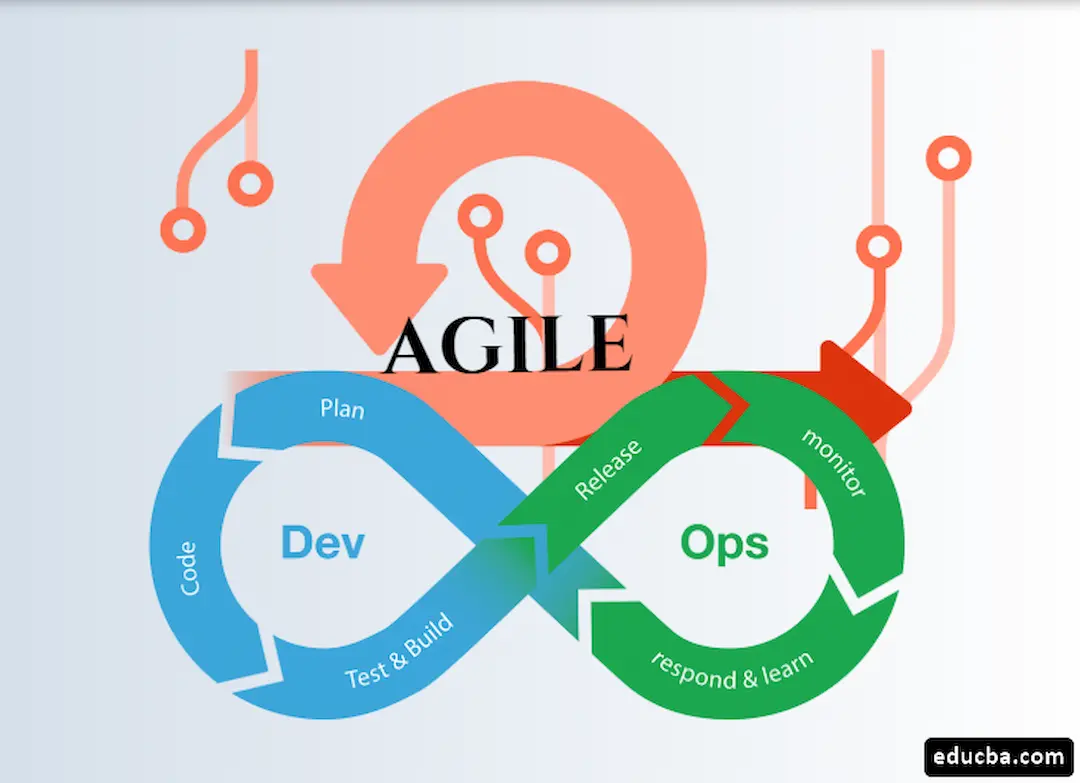
- The primary difference lies in what happens after the code is written. Agile typically covers software development, testing, and deployment, ending once the software is delivered. DevOps extends this lifecycle to include continuous operation, maintenance, and monitoring.
- In traditional Agile, different roles may still handle development, testing, and deployment. In a mature DevOps culture, these roles blur: development involves operations, and operations involve development.
- DevOps focuses heavily on automation and infrastructure to cut operational costs and reduce deployment friction. Agile focuses heavily on lean principles, empiricism, and reducing wasted effort.
Comparison Table:
| Feature | Agile | DevOps |
|---|---|---|
| Feedback Loop | Gets feedback primarily from customers. | Gets feedback from continuous internal monitoring and systems. |
| Release Cycle | Smaller release cycles (e.g., sprints). | Small release cycles with immediate, automated feedback. |
| Primary Focus | Focuses on speed and adaptability. | Focuses on speed, reliability, and extreme automation. |
| Scope of Work | Focuses mostly on the development phase. | Bridges the gap between business, development, and IT operations. |
Conclusion
Agile and DevOps are distinct, even though their similarities often lead people to conflate them. Misunderstanding this difference hurts the adoption of both.
For organizations and teams, it is vital to understand what Agile and DevOps are at a high level and how they can help teams work more efficiently, deliver high-quality products faster, and improve customer satisfaction.
Agile and DevOps are by no means adversaries. In the modern software revolution, they are powerful allies. Agile and DevOps collaborate in unison and should absolutely coexist within the same organization.