Sanplex vs Notion
2 hours agoPUBLISHED INAgile
 ali
ali 2026-09-17 14:56:00
 0
0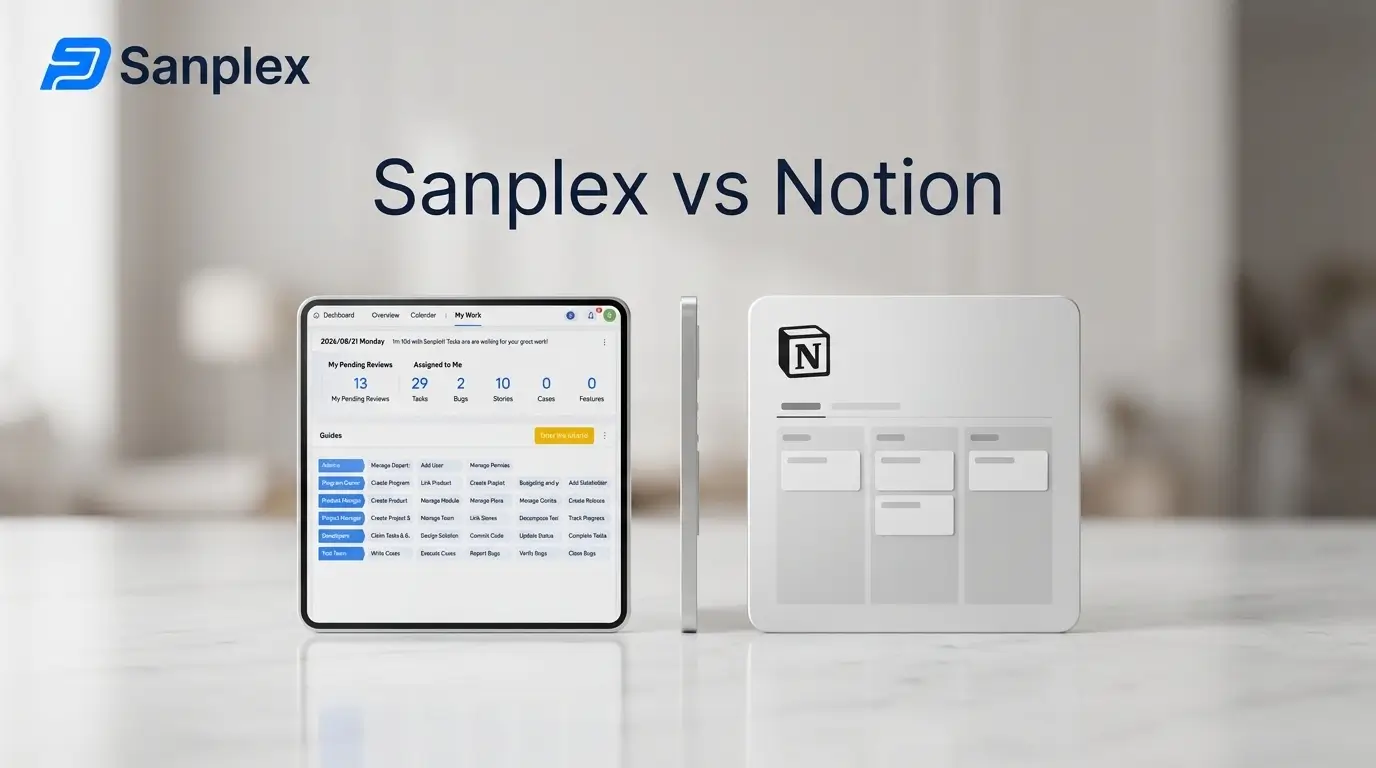
Notion's entire appeal is flexibility, pages, databases, and blocks that can be assembled into almost anything, a wiki, a task tracker, a CRM-like database, a company handbook. That's genuinely powerful, and it's also the source of Notion's biggest limitation for structured product development: whatever traceability or process discipline you want, you're building it yourself from generic building blocks, not getting it built in.
What You're Actually Building in Notion
A team can absolutely construct something resembling project tracking in Notion, a database of tasks, linked to a database of projects, with custom properties for status and priority. It takes real setup work, and it stays a general-purpose database structure rather than a system that understands what a requirement, a test case, or a sprint actually is. For teams that want that flexibility and don't need deep traceability, this is a feature, not a drawback. For teams that need real development lifecycle structure, it's extra work with no guarantee the result holds up as well as a purpose-built system.
The AI Pricing Shift Worth Knowing About
Notion restructured its AI pricing in 2025, retiring the standalone AI add-on and folding full AI features, Notion Agent, AI Meeting Notes, Enterprise Search, into the Business tier exclusively. That means the practical minimum for full AI access is $20 per user per month billed annually, not the $10 Plus tier some older reviews still reference. Worth confirming current tier details directly, since this is an area that's changed more than once recently.
Where Sanplex's Structure Actually Pays Off
Sanplex starts from the opposite direction: a four-tier structure (Program, Project, Product, Execution) built specifically to represent product development, with requirements linked natively to test cases and releases. Nothing needs to be assembled from generic blocks, the structure exists because that's what the platform is built around, not something a team configures from scratch.
Feature Comparison
|
Sanplex |
Notion |
|
|
Core philosophy |
Structured lifecycle management for product development |
Flexible all-purpose workspace: docs, wikis, databases, light project tracking |
|
Pricing |
Standard ~$39.9/user/year, Premium ~$59.9/user/year |
Plus $10/user/month, Business $20/user/month (full AI requires Business) |
|
Requirements/test traceability |
Native |
Not built in, would need manual database setup |
|
Structure model |
Program, Project, Product, Execution |
Pages and databases, structure is whatever you build |
|
Deployment |
Cloud or on-premises |
Cloud only |
Who Should Pick Which
Notion fits teams that want one flexible workspace for documentation, notes, and lightweight tracking, and don't mind investing setup time to shape it around their process. Sanplex fits teams doing real product or software development where requirements traceability, testing, and release coordination need to be structural, not something rebuilt from scratch in a general-purpose tool.
Quick Answers
Can Notion replace a dedicated project management tool?
For lightweight tracking, often yes. For structured development lifecycle needs, it typically requires significant manual setup with no built-in traceability.
Does Notion's Free plan work for a small team?
It's usable, but the 7-day page history and 10-guest limit push most collaborating teams toward Plus fairly quickly.
Is Notion AI included in the base price?
No longer as a cheap add-on, full AI features now require the Business tier at $20/user/month.
Does Sanplex offer the same document/wiki flexibility as Notion?
Sanplex includes embedded documentation features, though Notion's page-and-block flexibility for general knowledge management is broader by design.
Which is better for tracking requirements and test cases?
Sanplex, this is a native, structural feature rather than something built manually from a generic database.
Want to see structured traceability instead of a custom-built database?
Visit Sanplex or book a demo to see how it works.
Related Blogs
Sanplex vs Basecamp