
SKECHERS: Sanplex for all, all for Comfort
- Original
-
 Sanplex Content
 -
 2026-05-16 17:05:36
 -
 2478
2478
Catalog
Software solution provider Sanplex has partnered with Skechers to help it become the world’s most popular footwear brand, with sports functionality and a casual lifestyle at its core. Sanplex has improved the operational efficiency of Skechers’ IT department and opened up new opportunities for profit growth.
About SKECHERS
Skechers is a company specializing in the manufacture of shoes. Founded by Robert and Michael Greenberg in 1992 in Manhattan Beach, California, it specialized in boots and skateboard shoes before becoming a generalist in the field of sports footwear.
Skechers originated from a South California slang term, “energetic youngsters,” representing the youthful mentality of pursuing fashion and self-expression. Skechers hopes to convey a healthy and active living state through high-quality products so that millions of consumers can feel the brand concept of “Comfort for all, all for Comfort.” Skechers is now the second-largest footwear brand in the US market, following Nike.

Rapid business growth has led to the expansion of Skechers’ product lines. Skechers China now has more than 1,000 employees, while the IT department has reached more than 200 staff members. Facing increasingly large production business lines and the growing team size, Skechers chose Sanplex as the company’s work platform. Through the new collaborative working methods brought to the product, R&D, operation, and other departments, Sanplex has shortened the development iteration cycle by 2/3, effectively improving R&D efficiency.
Christine Mo, PMO at Skechers China, shared her insights in a recent interview:
“ Before we launched Sanplex, our rapidly expanding production team made it difficult to maintain our growth trajectory. Sanplex project management software completely connects our front, middle, and back ends, creating an integrated process from user stories to R&D management. The Agile R&D templates and workflows allow dozens of business lines and thousands of employees to collaborate efficiently. It has enabled the R&D team to improve efficiency far beyond our expectations, allowing the business to grow faster and more steadily.”
The Skechers IT Delivery Process
In brief, the delivery process within the Skechers IT department is structured as follows: Business Department —> ITBP —> IT Requirements (R&D Requirements) —> Review —> Iterative Development.
The Business Group represents the user side of the product, and its responsibility is to translate user stories to the IT Business Partner (ITBP). The ITBP is based on market needs and connects vital departments in a diversified management company. They must perform project feasibility analysis, risk assessment, project planning, project investment and revenue analysis, digital information management, and after-sales information feedback to improve customer satisfaction. The purpose of this function is to make the internal cooperation of the company seamless and achieve the smooth operation of all departments. ITBP is responsible for converting user stories into IT stories and transferring them to the IT department in a timely manner. After the final review by R&D staff, the IT stories are converted into product development documents for execution.
The Skechers IT team previously used Teambition to manage the company’s R&D process. However, as Teambition could only support the development of small teams, when their IT team exceeded 100 people, the challenges of the traditional waterfall model—with its long and inefficient processes—became more evident. To ensure that work was done in an organized manner and to continuously stimulate the creativity and potential of the team, the Skechers R&D team decided to improve the project process, restructure the team, and carry out an agile transformation. After several contacts with the Sanplex Business team, they finally decided to use Sanplex Premium for project and product whole-process management!
“ Using professional R&D management tools for refined management is not only about implementing Agile; it’s about building an efficient team that responds quickly to users. After collaborating with the Sanplex team and adopting the Scrum framework, we reorganized our processes. Each Scrum team is now more dynamic and accountable,” Christine noted.
Q1: Whole Lifecycle Solutions
Since opening in China in 2007, Skechers China has started its rapid expansion path. In recent years, the increase in capital investment and market competition pressure has put extremely high demands on the internal management of the Skechers team and rapid product iteration. From the product side, the whole process—from original demand collection to design, development, and release—should respond to the market more agilely. From the team perspective, all teams should work together to improve efficiency and be ready for product release.
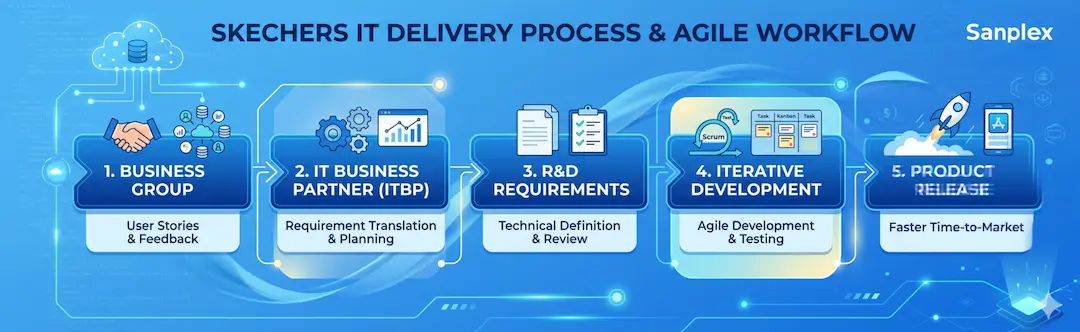
Skechers’ business departments represent product users. They do not always understand the details of the product development process, so there were often omissions or misunderstandings when passing user stories to developers. Many times, the final product didn’t exactly meet the user’s expectations. Thus, Sanplex helped them optimize the workflow by adding the role of ITBP to help the business group translate user needs into professional development stories. The benefit of this optimization is that the feedback time between the business side and technical implementation is immediately reduced, which not only promotes the technical agility of the product development team for rapid iteration but also achieves overall business agility.
In addition, the Skechers R&D department used various tools in the R&D process, but the data between these tools was not connected. The various aspects of R&D worked in silos, so they could only progress through manual collaboration, which lowered efficiency. The use of Sanplex integrates the R&D toolchain so that all links of product design, development, testing, launch, and validation are completed on the same platform, building a total lifecycle solution for the Skechers team.
Q2: Smooth and Transparent Cross-Departmental Collaboration
Sanplex has always insisted on transparent and efficient product delivery, keeping team members agile, self-driven, and collaborating efficiently.
Every story of each Skechers product line is recorded and assigned to a stakeholder, and the deadline is confirmed. Engineers can easily break down information barriers, get a clear view of upstream and downstream progress, and ensure the stories are implemented. For example, the system provides statistics on labor hours in each step: response time statistics for each phase from business stories to final conversion into product development documents, with customizable approval flows by specific dates.
The team can visualize the entire lifecycle of an order and the stage each order is in through the Sanplex project’s Kanban. After testers find product bugs, they can plan them into the related projects for management so that the development team can quickly plan to fix them in iterations according to the severity of the bugs.
Q3: Workload Management and Real-Time Adjustments
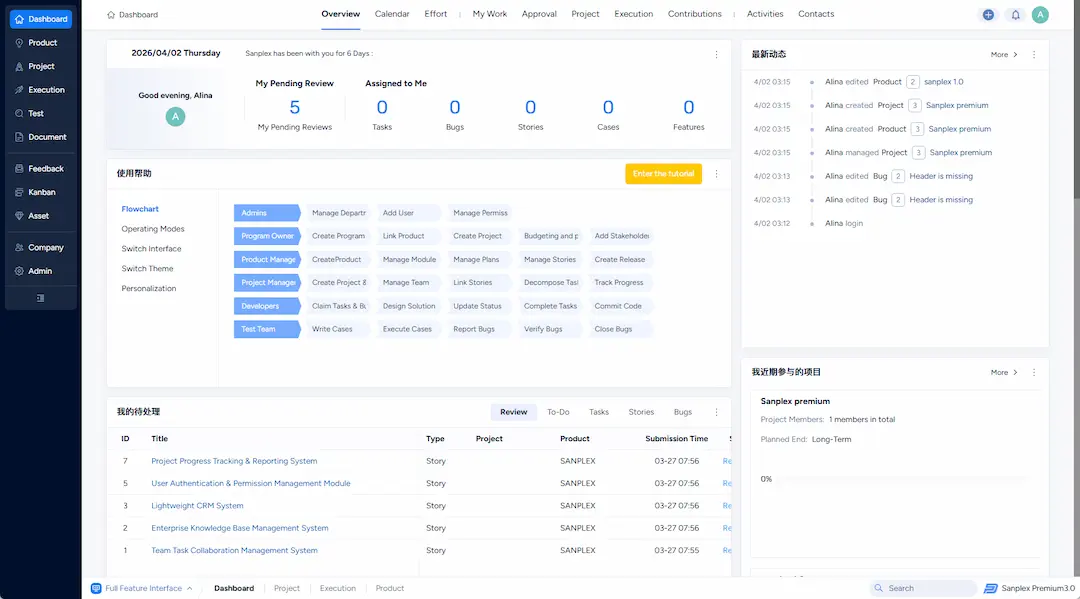
In an R&D team of 200+ employees, it’s important to know “who” is doing “what.” By using the “Statistics” function in the project, the Project Owner can view the total number of tasks for a product, finished and delayed tasks, and the task completion status of each project member. In “Report Management,” you can filter the data you want to view according to your needs. The “Statistics” feature provides statistical data in multiple dimensions and visualizes this data in various forms, such as bar and line graphs. By checking these data, the project owner can re-evaluate the project schedule, identify problems, and make adjustments in time.
Christine shared with us: “ In the past, I used to be very worried about the product manufacturing process, usually starting with the product stories and asking people one by one for progress updates. The progress of each step was very slow. After using Sanplex, as long as the product stories are confirmed, the overall structure is determined, the product roadmap is confirmed, and the tasks are broken down in the project Kanban board, I can basically feel at ease. The system automatically notifies me every day of the task progress, and I can save a lot of time to deal with more important things.”
Conclusion
In Sanplex, all processes are smooth, transparent, and goal-oriented, which helps the team keep abreast of the details and progress of each story and stimulates each member’s creativity and potential, enhancing their performance and sense of responsibility for the product. In such a challenging working atmosphere, every small team works towards a clear goal and devotes itself to polishing the product with full combativeness.
Sanplex has helped the Skechers team build a new organizational operation with high efficiency and collaboration. On the one hand, it ensures cross-team focus on user needs to create fast iterative products; on the other hand, it comprehensively improves team efficiency and performs a successful digital management transformation.