Sanplex vs Linear
2 hours agoPUBLISHED INAgile
 ali
ali 2026-09-17 15:11:00
 0
0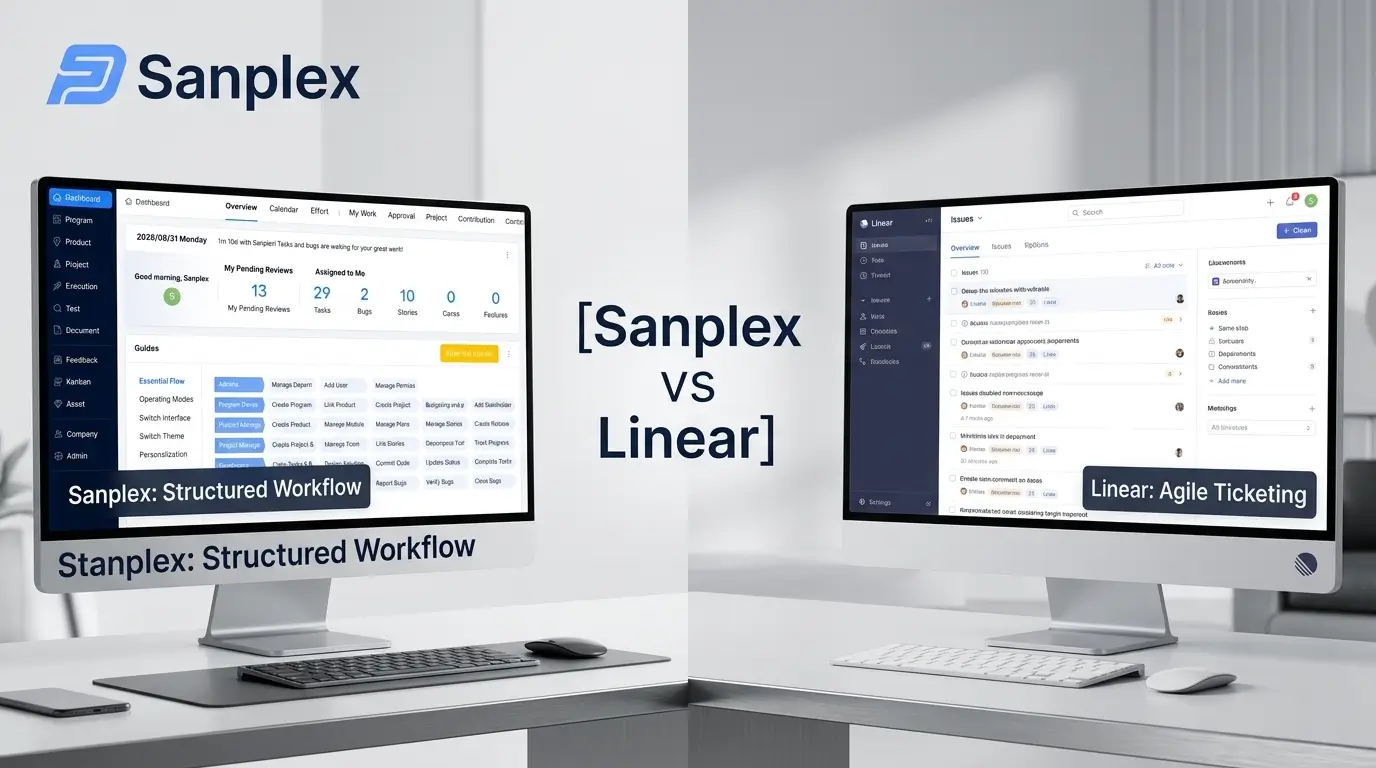
Linear built its reputation on being fast and opinionated, a keyboard-driven issue tracker that deliberately avoids the configuration sprawl of tools like Jira. That's a real strength for software teams who want speed over customization. It's also a real boundary, Linear is built specifically around engineering issue tracking, not the broader requirements-to-release lifecycle Sanplex is built around.
Linear's Opinionated Design Is the Whole Point
Linear organizes work around cycles, projects, and triage, with sensible defaults rather than endless configuration options. For a software team that wants to move fast without a lot of process overhead, that's genuinely appealing. The tradeoff is explicit in Linear's own positioning, it's not built for heavy customization, cross-functional non-engineering workflows, or self-hosting, if any of those matter to your team, Linear's opinionated model becomes a constraint rather than a convenience.
The Free Tier's Hard Wall
Linear's free plan is genuinely generous on team size, unlimited members, but caps out at 250 non-archived issues and 2 teams, enforced strictly with no grace period. New issue creation simply stops once you hit the cap. For an actively shipping product team, that limit arrives faster than it sounds, worth planning for the Basic tier from the start if your team is past the early-experimentation stage.
What Linear Doesn't Try to Be
Linear is explicit that it's not built for heavy cross-functional workflows or requirements-heavy development. Sanplex starts from the opposite assumption, requirements link natively to test cases and releases, and the platform supports software and hardware development together, not just software issue tracking. For teams whose process genuinely needs that structure, Linear's simplicity, however appealing, doesn't cover it.
Self-Hosting Is a Real Dividing Line
Linear is cloud-only, with no self-hosted option at any tier. Sanplex supports on-premises deployment alongside cloud, which matters directly for organizations with data residency requirements or a general preference for keeping data inside their own infrastructure.
Feature Comparison
|
Sanplex |
Linear |
|
|
Built for |
Full product lifecycle, requirements through release, software and hardware |
Software engineering issue tracking specifically |
|
Pricing |
Standard ~$39.9/user/year, Premium ~$59.9/user/year |
Basic $10/user/month, Business $16/user/month (both annual) |
|
Free tier limits |
Free tier available |
250 issues, 2 teams, hard cap with no grace period |
|
Requirements/test traceability |
Native |
Not built in, issue-tracking focused |
|
Deployment |
Cloud or on-premises |
Cloud only, no self-hosting |
Who Should Pick Which
Linear fits software engineering teams that want fast, opinionated issue tracking without configuration overhead, and don't need deep requirements traceability or hardware development support. Sanplex fits teams, software or hardware, that need the full lifecycle connected, requirements, testing, releases, especially where self-hosting or CMMI-aligned process discipline matters.
Worth Knowing
Can Linear handle non-engineering, cross-functional work?
Not natively well, it's explicitly built and opinionated around software engineering workflows specifically.
Does Linear's free plan work for an active product team?
Initially, but the 250-issue cap tends to arrive faster than expected for a team shipping regularly.
Can Linear be self-hosted for data control?
No, it's cloud-only across every tier, with no self-hosted option available.
Does Sanplex offer the same fast, minimal-configuration experience as Linear?
Sanplex is built around more structure by design, since that structure is what enables its requirements and traceability features, a different tradeoff than Linear's speed-first simplicity.
Which is better for hardware or mixed hardware-software development?
Sanplex, Linear is built specifically around software issue tracking rather than hardware development workflows.
Want to see full lifecycle structure with deployment flexibility?
Visit Sanplex or book a demo to see how it works.