Sanplex vs Redmine: Two Self-Hosted Options Compared
July 31, 2026PUBLISHED INWeekly Sharing
 ali
ali 2026-07-31 18:19:00
 0
0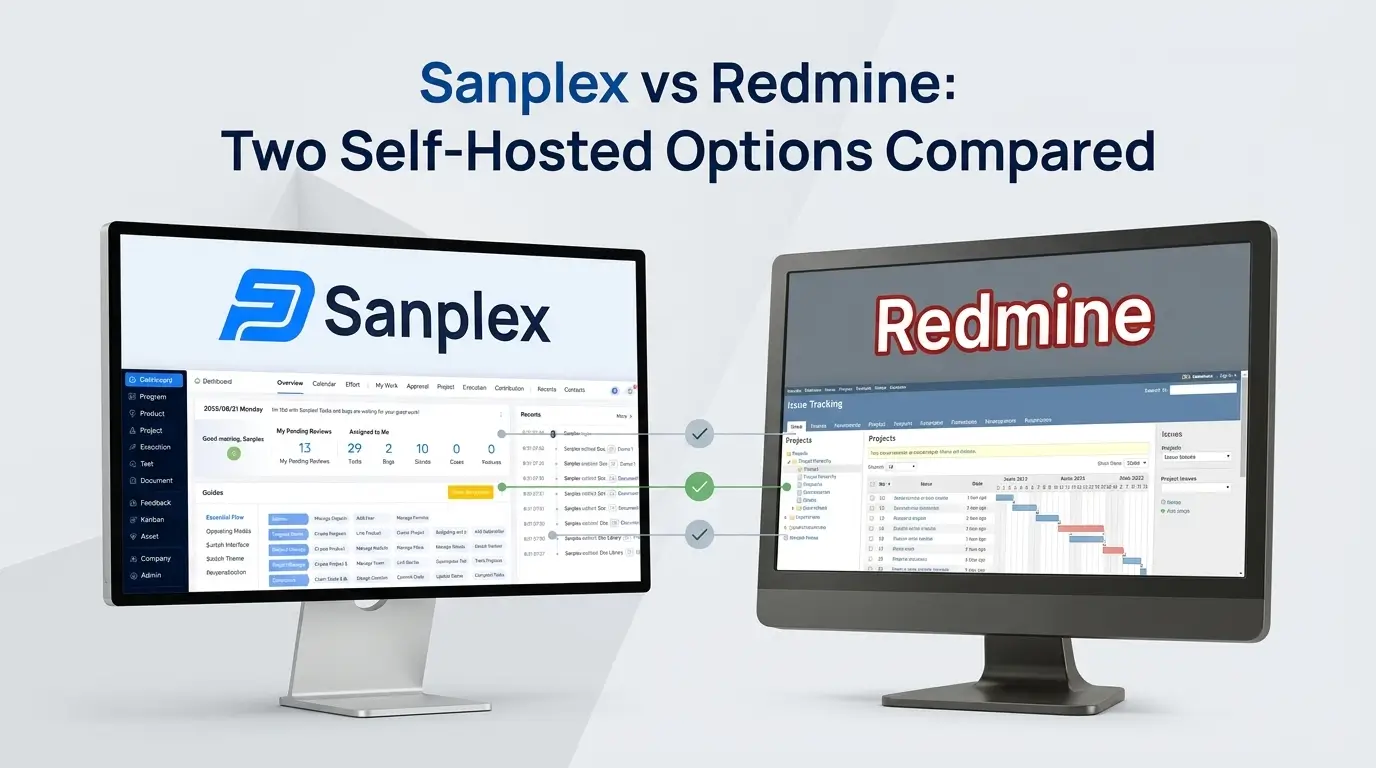
Self-hosted project management became a much busier market in late 2025, when Atlassian confirmed that Data Center products reach end of life on 28 March 2029, with new-customer sales already closed as of 30 March 2026. Organisations that cannot move to a multi-tenant cloud — for data residency, sovereignty, air-gap, or contractual reasons — are now shortlisting replacements, and Redmine and Sanplex regularly appear on the same list.
They are very different propositions. One is a mature open-source issue tracker you assemble into a platform. The other is a commercial lifecycle platform you deploy. This comparison covers what each actually costs, where each breaks down, and how to choose.
Where they agree
Both run on your infrastructure. Both keep your data inside your network boundary. Both offer role-based access control, LDAP integration, REST APIs, Gantt charts, and multi-project support. If self-hosting is a hard requirement, either satisfies it.
That is where the similarity ends.
Redmine: the open-source position
Redmine is a Ruby on Rails project management application released under GPL v2. It has been in continuous development since 2006 and remains actively maintained — version 7.0.0 shipped on 30 June 2026, with the 6.1.x, 6.0.x, and 5.1.x series receiving maintenance releases in mid-June 2026. The project targets minor releases roughly every three months and a major release annually on a best-effort basis, with the latest minor version fully supported and older lines receiving important security fixes only.
Out of the box you get multi-project support, flexible role-based access control, an issue tracking system, Gantt chart and calendar views, time tracking, a wiki and forums per project, file management, multiple LDAP authentication sources, and support for a very wide set of languages and databases.
The strengths are real. There is no licence cost. There is no vendor who can change the pricing model, deprecate your deployment option, or be acquired. The source is available, so anything can be modified. For a team with Ruby capability and unusual requirements, that combination is hard to beat.
The constraint is what is not included. Test case management, formal requirements management, program-level portfolio structure, agile boards, and release management are not core Redmine. Each is a plugin — from ecosystems such as RedmineUP, RedmineX, and Easy Redmine, or from individual maintainers.
The plugin maintenance question
This is the decisive practical issue and it deserves plain description rather than either dismissal or scare tactics.
Redmine plugins are maintained independently of Redmine. When a major version ships, each plugin must be updated by its own maintainer. Commercially backed plugins usually keep pace. Community plugins vary — some track releases closely, others lag by months, and some are abandoned.
The operational consequence: your upgrade cadence is set by your slowest plugin. A team running eight plugins across a Redmine 7 upgrade is waiting on eight independent maintainers, and if one is unmaintained, the choice is to fork it, replace it, drop the functionality, or stay on an older Redmine and accept a narrowing security support window.
This is not a criticism of the model — it is the model. Distributed maintenance is what open-source extensibility costs. It just needs to be a budgeted, staffed reality rather than a surprise discovered during a security patch window.
|
"Free" in self-hosted software means no licence fee. It has never meant no cost. The question is whether your total cost lands mostly in licences or mostly in engineering hours. |
Sanplex: the commercial platform position
Sanplex is a commercial ALM platform available in cloud and on-premises editions, with Free, Standard, and Premium tiers. The Free edition covers unlimited seats and unlimited projects.
Its structural difference from Redmine is that capabilities Redmine treats as plugins are modules of the base product: product management with story review and change control, project management across Scrum, Kanban, Waterfall, and hybrid modes, native test case management with suites and execution tracking, a document and knowledge module, feedback and ticket handling, Gantt charts, release management, and a four-tier program / project / product / execution hierarchy. Premium adds baseline, review, risk, opportunity, and process-tailoring modules aimed at CMMI Level 4 and 5 quantitative management.
The strengths. One upgrade path with no plugin coordination. Test management and traceability built in rather than assembled. Vendor support and implementation guidance on paid tiers. Structure above the project layer for organisations running multiple product lines.
The constraints, stated honestly. It is proprietary — you cannot inspect or modify the source, and you are dependent on one vendor's roadmap and continuity. Customisation happens within the extension framework and API rather than by editing the application. Paid tiers carry a per-user cost that Redmine does not.
Total cost of ownership
The licence line is the least interesting part of this comparison. Here is the fuller picture for a hypothetical 50-user engineering organisation over three years.
|
Cost component |
Redmine |
Sanplex |
|
Software licence |
None |
Free tier at zero; Standard and Premium per user per year |
|
Server infrastructure |
Yours |
Yours (on-premises) or included (cloud) |
|
Initial setup and configuration |
Rails deployment, database, mail, plugin selection |
Installer plus configuration |
|
Plugin/module licences |
Commercial plugin suites are chargeable |
Included in the tier |
|
Ongoing admin time |
Upgrades, plugin compatibility, security patching |
Upgrades, configuration |
|
Upgrade risk |
Coordinated across all plugin maintainers |
Single vendor path |
|
Support |
Community forums; paid support from third-party providers |
Community on Free; vendor support, training, and implementation guidance on paid tiers |
|
Customisation ceiling |
Unlimited — you have the source |
Extension framework, API, private modules |
The pattern that emerges in practice: Redmine's cost is denominated in engineering time and Sanplex's in licence spend. Teams with a platform engineer who already runs Rails applications often find Redmine genuinely cheap. Teams without that capability discover that "free" software with two days of admin attention per month is not free at all — it is a part-time salary allocated to tooling maintenance and invisible in the budget.
Feature comparison
|
Capability |
Redmine |
Sanplex |
|
Issue tracking |
Core, highly flexible trackers and custom fields |
Distinct native objects: story, task, bug, test case |
|
Agile boards |
Plugin |
Built in — Scrum, Kanban, WIP limits, multi-board |
|
Gantt chart |
Core (read-oriented); drag-and-drop editing via plugin |
Built in for phases and tasks |
|
Test case management |
Plugin |
Built in — case library, suites, execution, reporting |
|
Requirements traceability |
Issue relations; no dedicated matrix |
Story tracking matrix built in |
|
Document / knowledge base |
Per-project wiki and files |
Document module with spaces, permissions, versioning, online editing |
|
Service desk / feedback |
Plugin |
Feedback and ticket modules |
|
Program / portfolio layer |
Project hierarchy only |
Four-tier program / project / product / execution |
|
Release management |
Versions and roadmap |
Dedicated release module |
|
Waterfall and hybrid |
Achievable through configuration |
Explicitly supported modes |
|
Time tracking |
Core |
Work logs and timesheets |
|
Source availability |
GPL v2, full source |
Proprietary; open API and extension framework |
|
Deployment |
Self-hosted only |
Self-hosted or cloud |
Choosing between them
Choose Redmine when you have in-house Ruby or platform engineering capability; source availability or licence freedom is a requirement rather than a preference; your needs map closely to issue tracking, time tracking, and project structure; you are comfortable owning the plugin compatibility problem; or you have a genuinely unusual requirement that only source access can satisfy.
Choose Sanplex when test management and requirements traceability are central rather than optional; you run multiple product lines and need portfolio structure; you work to CMMI, regulatory, or formal process expectations; you want one supported upgrade path instead of a plugin matrix; you need waterfall or hybrid delivery alongside agile; or you have no engineering capacity to allocate to tooling maintenance and would rather that cost be a predictable licence line.
Either works when you simply need self-hosted issue tracking for a small team. At that scope both do the job, Redmine costs less, and the decision is not worth extended analysis.
Migration considerations
Redmine's REST API and database structure make export straightforward, which is one of the underrated advantages of open source. When moving to another platform:
1. Map trackers to object types deliberately. Redmine's flexible tracker model means a single instance may use one tracker for stories, bugs, and support requests simultaneously. Sanplex's distinct object types are a different shape and the mapping is a decision, not a script.
2. Custom fields are the long pole. Mature Redmine instances accumulate many. Audit which are actually populated before migrating them.
3. Plugin data may not have an export path. Data held by a plugin — test cases in a test management plugin, for example — often lacks a clean API. Extract it before you decommission anything.
4. Time entries matter more than expected. If you bill against them or use them for capacity planning, verify they survive the move with attribution intact.
Frequently asked questions
Is Redmine still actively maintained?
Yes. Redmine 7.0.0 was released on 30 June 2026, and the 6.1.x, 6.0.x, and 5.1.x series received maintenance releases in mid-June 2026. The project targets minor releases roughly quarterly and a major release annually, with security fixes issued as needed.
Does Redmine have test case management?
Not in core. Test case management is available through third-party plugins. Sanplex includes a test case library, test suites, execution tracking, and test reporting in the base product.
Is Redmine free?
Redmine is free of licence cost under GPL v2. It is not free of total cost — you pay for server infrastructure, installation, upgrades, security patching, plugin compatibility work, and any commercial plugin suites you adopt.
Which is better for a self-hosted Jira replacement?
It depends on which Jira capabilities you actually use. If you use Jira for issue tracking and little else, Redmine covers it. If your stack includes test management, Confluence-style documentation, service desk, and portfolio planning, Sanplex covers more of that in one product without assembling plugins.
Does Redmine have a Gantt chart?
Yes, Gantt chart and calendar views are core features. Interactive drag-and-drop scheduling generally requires a plugin. Sanplex includes drag-and-drop Gantt scheduling for phases and tasks natively.
What are the alternatives to Atlassian Data Center for self-hosted teams?
Since Data Center reaches end of life on 28 March 2029 and closed to new customers on 30 March 2026, the main self-hosted options are open-source platforms such as Redmine, commercial self-hosted ALM platforms including Sanplex, and other vendors that have retained a self-managed deployment model.
Related Blogs
Release Management Process for Multi-Product Teams