
Understanding Product Lifecycle Management Through Changing Requirements
-
 Sanplex Content
 -
 2020-12-17 17:50:29
 -
 3293
3293
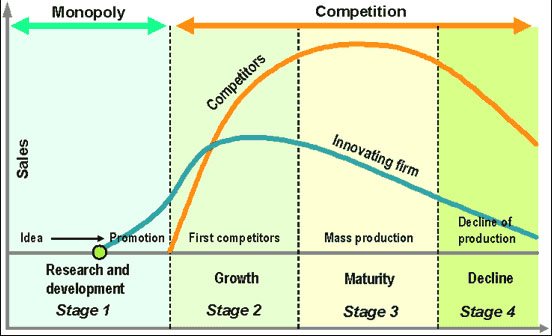
"Requirements" and "product lifecycle" are two highly crucial concepts in product management. As a product manager, a significant portion of your work revolves around them. In our daily routines, we are often accustomed to treating these two concepts independently. In reality, however, there is a deep and intrinsic connection between them. Today, we will discuss the relationship between the two.
Before diving into the discussion, let's briefly review the concept of the product lifecycle. Usually, we refer to the entire journey of a product—from market entry to retirement—as the product lifecycle. This generally includes four stages: introduction, growth, maturity, and decline. For each stage, we adopt different product strategies to manage the product effectively.
Ultimately, product lifecycle management is about identifying the current stage and formulating the corresponding strategy. At the same time, we know that requirements management runs through the entire lifespan of a product. Therefore, there must be a definitive connection between the phases of product requirements and the stages of the product lifecycle. The key question then arises: how do we identify and utilize this connection?
Let's first look at an example.
LED color TVs became mainstream in the market due to their energy efficiency, environmental friendliness, and high-definition quality. However, when LED TVs were first launched, they were quite expensive. Only a small segment of consumers could afford them, but some were willing to make the purchase anyway. These consumers were the "early adopters." At this stage, if a consumer wanted to buy this type of product, there were relatively few choices available.
However, with the continuous advancement of LED technology and the reduction in production costs, LED TVs became highly commoditized (affordable) in just a few years, giving consumers a wide array of choices. At this stage, consumers had to think carefully and do more research before making a final purchasing decision.
As LED TVs became ubiquitous and performance indicators continued to improve, the early adopters began to develop upgrade requirements. They would purchase new products based on their previous experiences and brand preferences.
Eventually, with the further evolution of TV technology and consumers' ever-growing expectations for better viewing experiences, consumers began looking for entirely new types of TVs. This led to a cycle where LED TVs originally replaced LCD TVs, but then newer technologies, such as 3D or OLED TVs, began to replace ordinary LED TVs.
Let's analyze this example from the perspective of the product lifecycle.
When LED TVs first entered the market, the product was in the introduction stage. As LED TVs developed, they entered the growth stage, followed by large-scale popularization in the maturity stage, and will eventually enter the decline stage (though it cannot be said that LED has fully declined just yet).
So, how do consumer requirements change throughout this process?
Looking first at the introduction stage, consumers had new viewing expectations due to the limitations of LCD TVs, even if they weren't entirely clear on the specific technical indicators. When manufacturers launched LED TVs, they used energy efficiency, green technology, and high definition as selling points to attract consumers looking for an upgrade.
At this point, consumers only have vague needs in their minds—they simply hope to improve their viewing experience without clear brand or feature preferences. Therefore, these types of needs are called "primary requirements."
As technology developed and costs decreased, more companies entered the market, and consumers began to pay closer attention to these products. Consequently, consumers had more choices. Companies continuously introduced new models to meet diverse consumer needs, improving performance and lowering costs. At this stage, the needs are referred to as "selective requirements."
With the widespread popularization of LED TVs, early buyers developed the need for replacements. At this time, they made choices based on their previous purchase experiences and brand preferences. The needs at this stage are called "repetitive requirements."
Similarly, as consumers' expectations for viewing experiences continue to rise, naturally, completely new requirements will emerge.
To briefly summarize the relationship between "requirements" and the "product lifecycle":
- In the introduction stage of the product lifecycle, consumer needs are "primary requirements."
- In the growth stage of the product lifecycle, consumer needs are "selective requirements."
- In the maturity stage of the product lifecycle, consumer needs are "repetitive requirements."
- In the decline stage of the product lifecycle, consumer needs evolve into "new requirements."
This evolution of requirements across different stages of the product lifecycle is especially prominent in the Fast-Moving Consumer Goods (FMCG) and consumer electronics industries. So, what is the practical significance of understanding this relationship for our daily work?
We know that the biggest challenge in product lifecycle management is proactively identifying which stage the product is entering. The indicators typically used to evaluate this include sales volume, growth rate, unit cost, user purchase intention, competitive landscape, dealer willingness, and profit prospects. If we understand the relationship between requirements and the product lifecycle, we can use the shift in consumer requirements as an additional, vital indicator to evaluate the lifecycle stage. Product managers must remain highly sensitive to these changing requirements.
Conversely, we can also use our assessment of the product lifecycle as a tool to anticipate changes in requirements, utilizing lifecycle transitions to predict what type of needs users will have next.
In product management, it is not just requirements and lifecycle management that are connected; many aspects of the job are intertwined. As a product manager, if you can identify the underlying connections between these tasks and create a cohesive strategy, it will be immensely beneficial to your actual work.