Kanban vs Scrum: Which Fits Your Team
August 18, 2026PUBLISHED INAgile
 ali
ali 2026-08-18 00:58:00
 0
0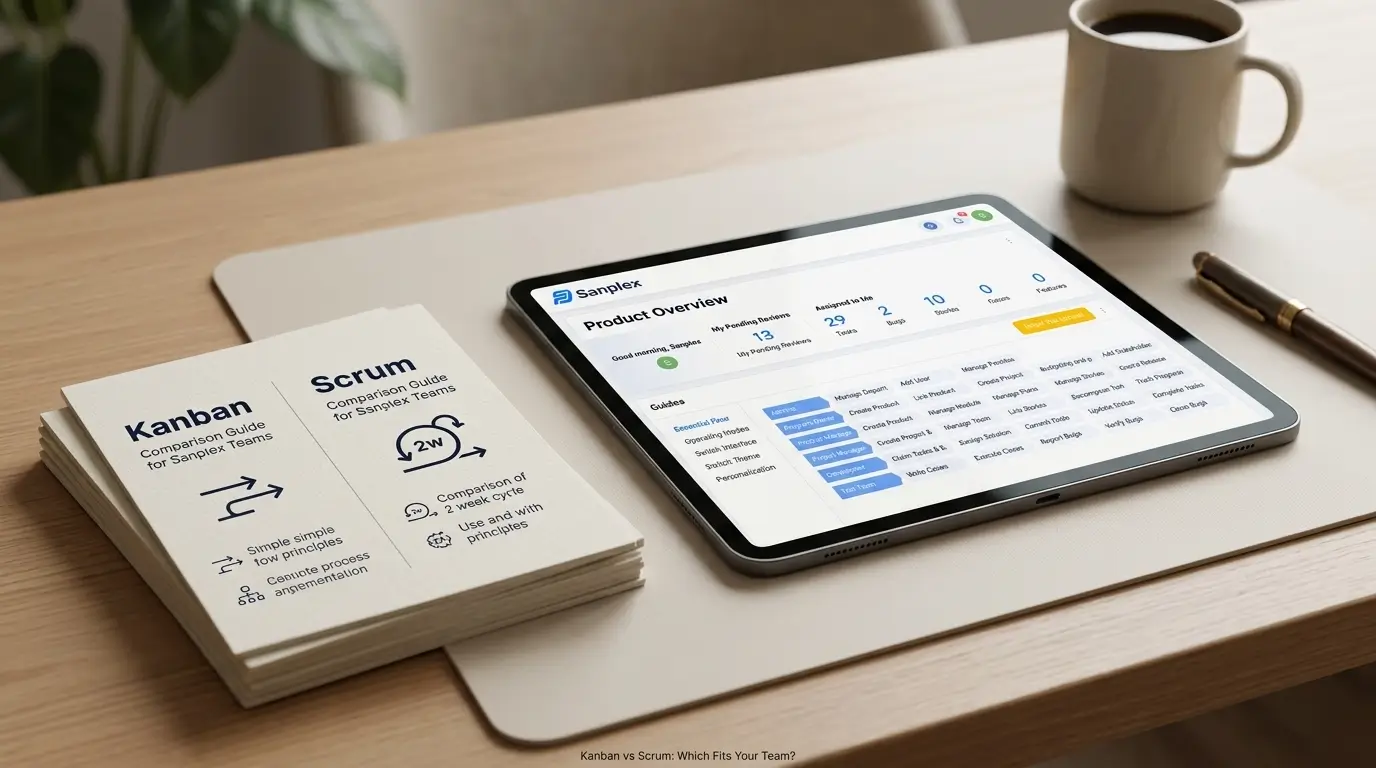
Kanban and Scrum both fall under the agile umbrella, and both get recommended constantly without much explanation of when one actually fits better than the other. The short version: Scrum imposes structure through fixed time boxes and defined roles, which suits work that benefits from regular planning and review cycles. Kanban imposes structure through visualized flow and work-in-progress limits, which suits continuous, less predictable streams of work. Neither is more "agile" than the other, they solve different coordination problems.
How Scrum Actually Works
Scrum organizes work into fixed-length sprints, commonly two weeks, with a defined sequence: sprint planning at the start, daily standups throughout, a sprint review and retrospective at the end. It has explicit roles, typically a Scrum Master and Product Owner, and the sprint boundary itself creates a regular rhythm for planning, adjusting, and reflecting. This structure is genuinely useful for feature-driven product development, where breaking work into a plannable set of items every couple of weeks gives the team and stakeholders a predictable cadence to work against.
How Kanban Actually Works
Kanban has no fixed iterations. Work flows continuously through a visualized board, and the core discipline is limiting work in progress, capping how many items can be in a given stage at once, so the team focuses on finishing work rather than starting more of it. There's no prescribed cadence for planning or review, though most teams still hold regular check-ins informally. This fits work that arrives unpredictably and needs to be picked up quickly, support tickets, ongoing maintenance, operations work, better than a framework built around planning two weeks of work in advance.
Where Each One Tends to Break Down
Scrum struggles when work genuinely can't be planned two weeks out, support-heavy teams fielding a constant, unpredictable stream of requests often find sprint planning becomes a fiction, since half the sprint gets consumed by things nobody could have planned for. Kanban struggles when a team needs the forcing function of a hard deadline and a defined scope, without sprint boundaries, work can drift without the periodic checkpoint that pushes a team to commit to and deliver a specific set of outcomes.
Signs Scrum Is the Better Fit
Work is genuinely plannable in two-to-four week chunks. The team benefits from a regular cadence of commitment and review. Stakeholders want predictable delivery checkpoints tied to specific outcomes, not just a general sense of ongoing progress. Product development with a roadmap and defined feature sets tends to fit this pattern well.
Signs Kanban Is the Better Fit
Work arrives unpredictably and needs fast turnaround rather than batched planning. The team's main challenge is too much work in progress at once, not a lack of structure around planning cycles. Support, operations, and maintenance-heavy work tend to fit this pattern well, since the value is in continuous flow, not periodic delivery.
You Don't Actually Have to Choose Just One
Plenty of teams run a hybrid, sometimes called Scrumban, using sprint-style planning for feature work while handling support or maintenance tickets through a Kanban flow alongside it. This works best when the underlying system doesn't force an artificial choice between the two. Sanplex supports both Kanban and Scrum natively within the same platform, along with Waterfall and hybrid approaches, so a team can run sprint-based planning for one workstream and a continuous Kanban flow for another without needing two separate tools that don't talk to each other.
Frequently Asked Questions
Is Kanban less structured than Scrum?
Different, not necessarily less. Kanban's structure comes from visualized flow and WIP limits rather than fixed time boxes and defined roles, but it's still a disciplined system when followed properly.
Can a team switch from Scrum to Kanban, or vice versa?
Yes, and it's fairly common as a team's work pattern changes. The switch is usually smoother when the underlying tool supports both without requiring a full platform migration.
What is Scrumban?
A hybrid approach combining Scrum's planning cadence with Kanban's continuous flow and WIP limits, often used when a team has both plannable feature work and unpredictable support or maintenance work.
Does Kanban work for software development, or just operations?
It works for both. Many software teams use Kanban for continuous delivery workflows, particularly when release cycles are frequent and less tied to fixed sprint boundaries.
Which is easier for a new team to adopt?
Kanban generally has a lower adoption barrier since it doesn't require defined roles or ceremony. Scrum's structure can take longer to establish but provides more built-in rhythm once adopted.
Want to run Scrum and Kanban side by side in one system?
Book a demo and bring your team's actual workflow mix to the conversation.
Related Blogs
How to Set Up a CMMI-Compliant Workflow