SWOT vs PESTLE Analysis for Project Managers
2 hours agoPUBLISHED INAgile
 ali
ali 2026-10-16 15:05:00
 0
0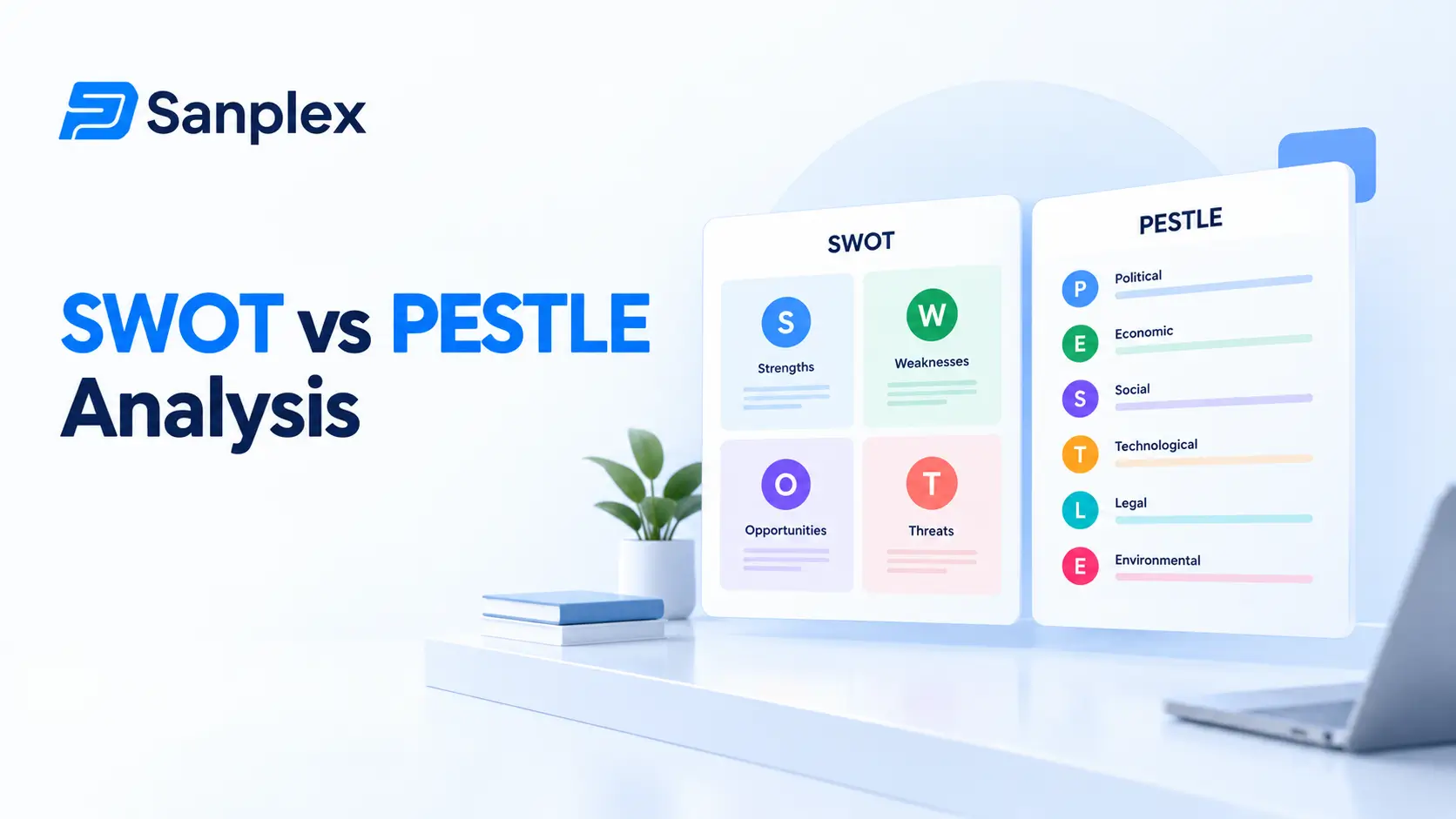
Most project managers meet frameworks like SWOT in a workshop and promptly forget them. Which is a shame, because used properly, a simple framework can save you from a nasty surprise six months into a project. A new regulation, a shift in what customers expect, a technology that makes your plan look outdated. These things don't announce themselves.
That's where PESTLE analysis helps. In this article we'll compare it with SWOT, show how each one works, and run through project style examples so you can use them on your own work.
What is SWOT analysis?
SWOT stands for strengths, weaknesses, opportunities and threats. It splits into two halves. Strengths and weaknesses are internal, meaning things about your team or product that you can influence. Opportunities and threats are external, things happening around you that you can't control but can respond to.
Strengths
What your team or product does well. A deep knowledge of one industry, a loyal customer base, a fast release process.
Weaknesses
Where you fall short. A small team, technical debt, no one with a particular skill.
Opportunities
Outside chances you could use. A competitor leaving the market, a new customer need, a partner offering an integration.
Threats
Outside risks. A new competitor, rising costs, a change in rules.
What is PESTLE analysis?
PESTLE analysis is a way of scanning the external environment around a project or product. The letters stand for political, economic, social, technological, legal and environmental factors. It doesn't look at your own strengths at all. It simply asks what's changing around you, and whether that matters.
|
Factor |
Question to ask |
Project example |
|---|---|---|
|
Political |
How might government decisions affect us? |
Trade rules that change the cost of imported hardware |
|
Economic |
How do money matters affect us? |
Customers cutting software budgets |
|
Social |
How are people and habits changing? |
More staff working remotely, so demand for online tools rises |
|
Technological |
What new tech helps or threatens us? |
AI features becoming a normal expectation |
|
Legal |
What laws and rules apply? |
Data protection rules for storing customer data |
|
Environmental |
How do climate and sustainability matter? |
Customers asking for energy efficient hosting |
A PESTLE scan for a software project
Here's one more example, this time for a team planning to store customer data in a new region.
|
Factor |
What the team found |
|---|---|
|
Political |
Stable relations with the target region, no known trade barriers |
|
Economic |
Customers there are growing in number but price sensitive |
|
Social |
Strong expectation that data stays within the country |
|
Technological |
Local cloud providers available, but fewer than at home |
|
Legal |
Data residency and privacy rules apply, legal review needed |
|
Environmental |
Some customers ask about the energy use of data centers |
Two rows drive the decisions here: legal and social. Everything else is background. That's normal. A good scan rarely lights up all six equally.
SWOT vs PESTLE: the key differences
|
SWOT |
PESTLE |
|
|---|---|---|
|
Looks at |
Inside and outside |
Outside only |
|
Main goal |
Summarize your position |
Scan the environment for change |
|
Best used |
Before making a decision or plan |
At the start of a project or strategy review |
|
Output |
Four lists |
Six lists of external factors |
|
Weakness |
Can be shallow and subjective |
Can be too broad if unfocused |
They aren't rivals. PESTLE feeds the opportunities and threats part of a SWOT. Do the wider scan first, then narrow it down.
A worked example for a product team
Imagine a team planning to add online payments to its project management product. They begin with a PESTLE scan, and the legal and technological rows stand out. Payment and data protection rules apply, and customers increasingly expect several ways to pay.
Those findings flow into a SWOT. Strength: a loyal customer base who already trust the product. Weakness: no in house experience with payments. Opportunity: customers asking for it. Threat: competitors who already offer it. The plan that follows is sensible: partner with a payment provider rather than build everything, and get the legal review done before development starts.
A SWOT example for a project
|
Helpful |
Harmful |
|
|---|---|---|
|
Internal |
Strengths: experienced team, strong customer relationships, fast release process |
Weaknesses: no payments experience, small QA team, aging code in the billing module |
|
External |
Opportunities: customers asking for the feature, partners offering ready made integrations |
Threats: competitors already offer it, new rules on handling payments |
Read it across and it tells a story. We're trusted, we're quick, but we're thin on payments knowledge and the market isn't waiting. That points toward partnering, not building from scratch.
Questions that make each PESTLE factor useful
-
Political: which decisions by governments could change our costs or access?
-
Economic: what happens to our customers' budgets if the economy tightens?
-
Social: what do people now expect that they didn't two years ago?
-
Technological: which new tools could make our approach look dated?
-
Legal: which rules apply to the data and the people we work with?
-
Environmental: do customers or regulators care about our footprint?
Other frameworks worth knowing
SWOT and PESTLE aren't the only options. Porter's Five Forces looks at competition in an industry through five pressures, such as new entrants and the power of buyers. Goal frameworks like OKRs help turn the strategy into measurable targets. You don't need all of them. Pick one that answers the question you actually have, and drop it if it doesn't help.
How to run a session in about ninety minutes
-
Pick one clear question, such as "Should we enter this market?"
-
Invite five to eight people from different areas, like product, engineering, support and sales
-
Spend thirty minutes on PESTLE, with one factor at a time
-
Spend thirty minutes on SWOT, using what the PESTLE found
-
Spend twenty minutes picking the top three items and assigning follow ups
That last part matters. A wall full of sticky notes isn't a result. A short list of decisions with owners is.
When these frameworks aren't enough
I should be honest about the limits. SWOT and PESTLE are thinking aids, not crystal balls. They organize what you already know and what the room is willing to say. If your team is missing key information, such as real customer data or legal advice, the framework will just organize your guesses neatly.
Use them to start the conversation and to expose gaps. Then go and fill those gaps with research, customer interviews and expert opinions, and revisit the analysis.
Turning findings into decisions
For every item you rate as important, write down one of four responses: act now, prepare for later, watch, or ignore. It takes ten minutes and prevents the all too common ending where a long list is admired and then filed away.
-
Act now: assign an owner and a date
-
Prepare: add it to the roadmap or risk register
-
Watch: pick a trigger that would change your mind
-
Ignore: say why, so you don't debate it again
Where these frameworks fit in your planning
Frameworks work best when they connect to real planning. A PESTLE scan at the start of a product's life helps you spot what could change over its lifetime, which ties in with our piece on understanding product lifecycle management. The findings then shape your product roadmap planning, as risks and opportunities turn into themes.
For bigger change programmes, these tools help avoid expensive mistakes too. Our look at digital transformation strategies (IT strategy pitfalls) covers what tends to go wrong when strategy skips the outside view.
Who should be in the room
The value of a SWOT or PESTLE session comes from the mix of people, not the template. Engineers know where the code is fragile. Support knows what customers complain about. Sales hears what competitors are offering. A project manager alone in a meeting room can only guess at most of this.
Keep the group small enough that everyone speaks, and ask the quietest people first. They've often spotted the thing everyone else walked past. Treat their remarks as data, not as interruptions.
Mistakes to avoid
Listing without prioritizing
Twenty items in every box helps nobody. Pick the few that really matter.
Being vague
"Technology is changing" says nothing. "Customers expect AI search in the product by next year" is specific enough to act on.
Doing it once
The outside world keeps moving. Revisit the scan every six months, or when something big changes.
Doing it alone
One person's view is a blind spot. Include people close to customers and close to the code.
Capturing the results in Sanplex
Store the analysis in your project wiki, and turn each follow up into a task with an owner in Sanplex, so the workshop produces action instead of a photograph of a whiteboard.
Frequently asked questions
What is PESTLE analysis?
PESTLE analysis is a framework for scanning the external environment, covering political, economic, social, technological, legal and environmental factors that could affect a project or business.
What is the difference between SWOT and PESTLE?
SWOT covers both internal factors (strengths, weaknesses) and external ones (opportunities, threats). PESTLE looks only at external factors, in more detail and across six categories.
When should project managers use PESTLE analysis?
At the start of a project or major phase, when entering a new market, or when something in the environment changes, like new regulations or technology.
Can SWOT and PESTLE be used together?
Yes. A PESTLE scan identifies external changes, which then feed the opportunities and threats sections of a SWOT analysis.
How often should I update a PESTLE analysis?
Roughly every six months for long running projects or products, or whenever a significant external change happens.
|
Turn workshop findings into action Keep your analysis in the Sanplex wiki and assign follow ups as tasks. Start free. Start with Sanplex |
Related Blogs
Gantt Chart vs Kanban Board: Which Should You Use?