POC vs MVP: Proof of Concept vs Minimum Viable Product
3 hours agoPUBLISHED INAgile
 ali
ali 2026-10-06 13:45:00
 0
0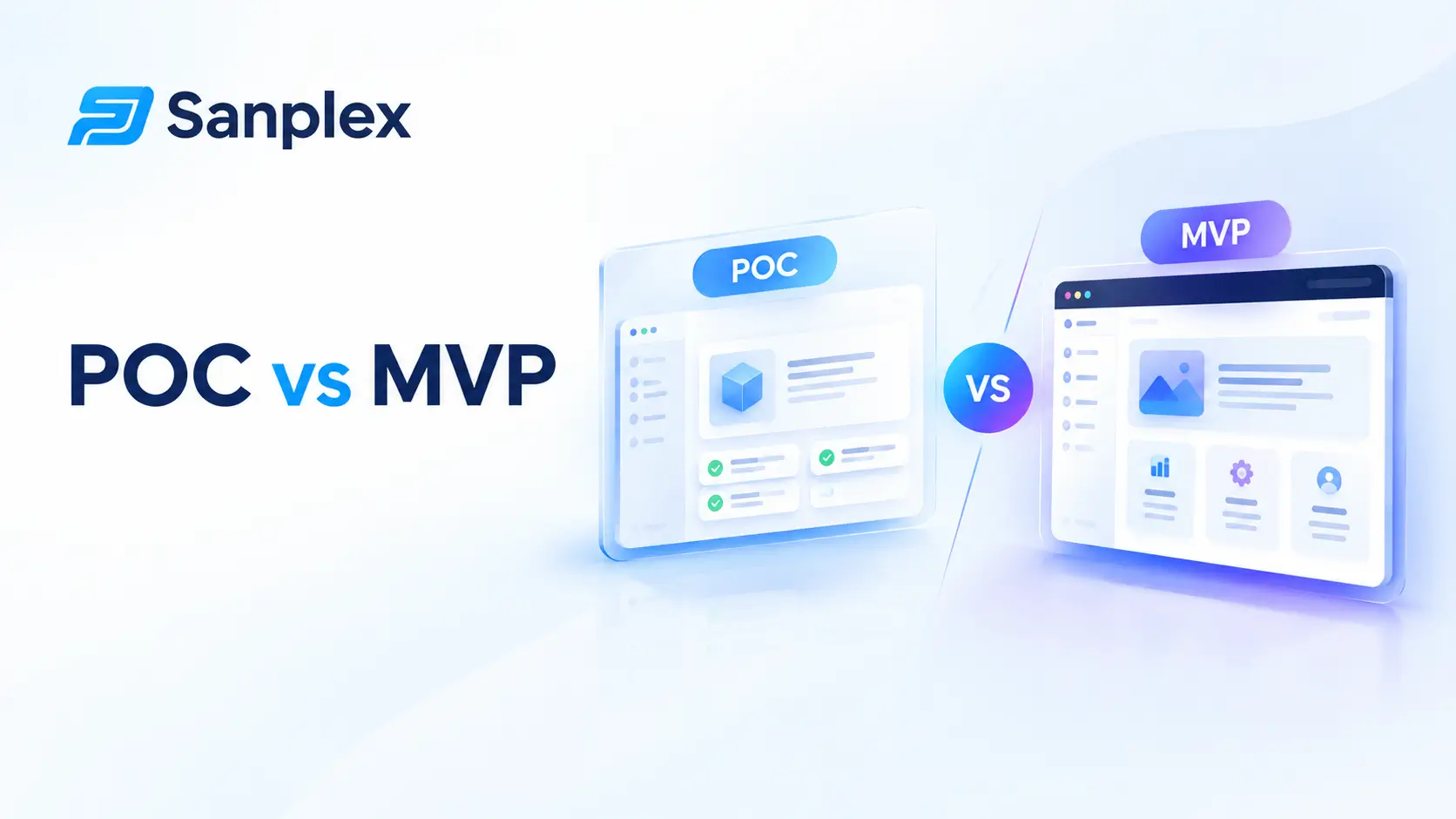
I'll admit I let it slide the first time someone said "let's just do a quick POC" about something that was clearly an MVP. Three months later the demo looked lovely and not one customer had touched it. A POC and an MVP are not the same experiment. They go after different risks, and mixing them up costs real money.
So here's what we'll do. We'll look at what each one is, put them side by side, walk through one example, and then talk about when to pick which. If you want the longer story on the second half of the pair, our guide on what is an MVP goes deeper.
What is a POC (proof of concept)?
A POC is a small, quick experiment that tests whether one specific idea is possible. That's all. It's built for the team and maybe a couple of decision makers, never for customers. It can be rough, hard coded and held together with tape, because its only job is to give you a yes or a no.
The kind of questions a POC answers
-
Can our system handle 10,000 live updates a second?
-
Will this partner's API actually behave when we call it all day?
-
Is this model accurate enough on our own historical data?
-
Can we connect these two tools without a rewrite?
Once you have the answer, the POC has done its job. Most teams bin the code afterwards, and that's healthy. Nobody should feel bad about throwing away something that was never meant to last.
What is an MVP?
A minimum viable product is the smallest version of a product that real people can use to get real value. Notice the word viable. Minimum doesn't mean sloppy. It means you build only what's needed to find out whether people want the thing.
What an MVP needs to have
-
A working way for users to get started
-
The one core job done properly, even if nothing else is
-
Enough stability that people can actually rely on it
-
Some way to measure what happens, whether that's sign ups, usage or feedback
The question an MVP answers is about demand. Will people use it, come back to it, maybe pay for it? A POC can't tell you any of that, however good the demo looks.
POC vs MVP at a glance
|
POC |
MVP |
|
|---|---|---|
|
Main question |
Can we build this? |
Do people want this? |
|
Risk it tests |
Technical risk |
Market risk |
|
Audience |
Your team and stakeholders |
Real customers |
|
Quality bar |
Rough is fine |
Stable enough to use |
|
Typical length |
Days to a few weeks |
Weeks to a few months |
|
What happens next |
Usually thrown away |
Built on and improved |
If you're unsure which one you're about to build, ask who it's for. Only your own team? Probably a POC. Paying or free customers? That's an MVP.
An example from a task tracker
Step one, the POC
Say a product team wants automatic effort estimates in their task tracker. The first unknown is technical. Can a model guess well enough from old tickets? So an engineer grabs 200 closed tickets, tries a basic model and compares its guesses with what really happened. The result is decent on small tasks and pretty bad on big ones. Useful to know, and it cost one engineer about a week.
Step two, the MVP
Armed with that, the team builds a small "Suggest estimate" button, limited to small tasks, and releases it to twenty friendly customers. Now the question has changed completely. Do people click it? Do they accept the suggestion or overwrite it? That feedback decides whether the feature earns a place on the roadmap.
When to use a POC, an MVP, or both
Start with a POC when
The biggest unknown is whether the technology, the integration or the approach works at all. No point testing demand for something you can't build.
Go straight to an MVP when
The technology is well understood and the open question is whether customers care. This is the common case for most web and software features.
Do both when
You face both risks. Prove it can work cheaply first, then test demand with real users. In that order, please.
Skip both when
The change is small and low risk. Not every feature needs an experiment, and some teams overdo it.
How to decide in five minutes
When a team isn't sure which experiment to run, I walk through a handful of questions. Your answers usually make the choice obvious.
-
What's the scariest assumption in this idea? If it's "can we build it," run a POC
-
Do we already know the technology works? Then skip ahead to an MVP
-
Who needs to see the result? Only us means POC, customers means MVP
-
What would make us stop? If you can't answer, write it down before you start
-
How much are we willing to spend finding out? Be honest, and cap it
That fourth question is the one people skip. An experiment without a stopping rule isn't an experiment, it's a project with good PR.
What success looks like for each
A successful POC
A clear answer, even if the answer is no. Honestly, a POC that kills a bad idea in two weeks is a big win. It saved you the six months you'd have spent on it.
A successful MVP
Real behavior from real people. Sign ups, repeat use, someone asking when the next feature is coming. Compliments don't count. Lots of friendly people say "nice" and never open the thing again.
Where a prototype fits
You'll also hear people say prototype. That's usually a clickable mockup that tests how something feels to use. It sits in between: more about design than a POC, and far less functional than an MVP. Handy when the doubt is about the interface, not the engine.
Mistakes that turn a POC or MVP into a problem
The POC that quietly becomes the product
"It already works, let's just ship it." Rough code goes to customers and everyone pays for it later. Plan to rebuild properly.
An MVP that's half a product
If users can't finish the core job, you learn nothing about demand. They just leave.
No success criteria
Decide before you start what counts as a pass. Otherwise every result gets explained away, good or bad.
Forgetting to write down what you learned
Both experiments exist to produce a decision. If nobody records it, you'll run the same test again in a year.
Fitting both into your roadmap
I treat a POC as a short discovery task that comes before any commitment, and the MVP as the first real delivery item for a new idea. Once the MVP scope is clear, write it down. Our free PRD template gives you a structure to start from. Then break the scope into work items by following the steps in how to set up a product backlog.
Where Sanplex fits
Sanplex keeps the pieces together: backlog, requirements documents in the built in wiki, and the sprints that deliver them. So when a POC says go, the jump to a first release doesn't mean moving everything into a new tool.
Frequently asked questions
What is the difference between a POC and an MVP?
A POC tests whether an idea is technically possible and is mostly for your own team. An MVP is a working, minimal product released to real users to test demand. One reduces technical risk, the other reduces market risk.
Do I need a POC before building an MVP?
Not always. If the technology is well known, go straight to the MVP. A POC earns its keep when you honestly don't know whether the approach will work.
Is a POC the same as a prototype?
No. A POC proves something can work. A prototype shows how it might look and feel, often as a clickable mockup with nothing real behind it.
How long should a POC take?
Usually a few days to a few weeks. If it drags on past that, it's probably trying to answer more than one question.
Who should be involved in a POC?
Usually a couple of engineers and whoever owns the decision. You don't need a big team, and you don't need customers yet. Keep it small enough to finish quickly.
Can I build my MVP on top of POC code?
You can, but I'd think twice. POC code was never meant for customers. Most teams do better using what they learned and rebuilding the foundation.
|
Planning your next MVP? Keep your backlog, requirements and sprints in one place with Sanplex. Start free and try it on your own project. Start with Sanplex |
Related Blogs
Definition of Done vs Acceptance Criteria: Key Differences