
Project Settings
1. Introduction of Sanplex features
1.1. Core Management Framework
1.1.1 Program
1.1.2 Project
1.1.3 Product
1.1.4 Execution
1.1.5 Management Models
1.2. Dashboard
1.2.1 Getting Started with Tutorials
1.2.2 Quick Add
1.2.3 Notification Center
1.2.4 Effort Tracking
1.2.5 Dashboard - Project and Execution
1.2.6 Dashboard - My Work, Contribution, and Recents
1.2.7 Dashboard - Approval
1.2.8 Contacts
1.3. Program
1.3.1 Program List
1.3.2 Program Kanban
1.3.3 Create Program
1.3.4 Create Sub-Programs
1.3.5 Project Charter Management
1.4. Product
1.4.1 Create Product
1.4.2 Manage Modules
1.4.3 Multi-Branch and Multi-Platform Management
1.4.4 Manage Plans
1.4.5 Manage Requirements
1.4.6 Requirement Reviews
1.4.7 Requirement Status and Phase
1.4.8 Create Releases
1.4.9 Track Progress
1.4.10 Business Requirements and Multi-Level Requirements
1.5. Project
1.5.1 Scrum Project
1.5.2. Waterfall Project
1.5.2.1 Manage Project Phases
1.5.2.2 Project Design
1.5.2.3 Project Matrix
1.5.2.4 Project Reports and Earned Value Management
1.5.2.5 Project Baselines
1.5.2.6 Project Change
1.5.3. Kanban Project
1.5.3.1 Set Up Kanban Projects
1.5.3.2 Configure Kanban Boards
1.5.3.3 Use Kanban Boards
1.5.4 Hybrid Agile Project
1.5.5 Hybrid Waterfall Project
1.5.6. Project Settings
1.5.6.1 Project Setup
1.5.6.2 Project Executions
1.5.6.3 Project Requirements
1.5.6.4 Project Builds
1.5.6.5 Project Tests
1.6. Admin Settings
1.6.1 Confluence Data Import
1.7. Workflow

Project Requirements

2026-08-26 00:16:39
Sanplex Content
385
Last edited by Jing WANG on 2026-08-26 11:29:06
Share links
Summary: Learn how to create, link, configure, and manage project requirements through Stories, use Epic, Requirement, and Story concepts, and track Stories within project Executions.

Project requirements are managed through the Story feature in Sanplex. After opening a specific project, you can create Stories directly or link existing Stories from an associated Product.

The following example uses a Waterfall project to explain how project requirements are managed.

Go to Project > Select a Waterfall Project > Story. Click Create Story to create a Story directly, or click Link Stories to link Stories from an associated Product.

The project Story page provides a unified view for managing Story items and their hierarchy. You can filter Stories by hierarchy and status, search for specific items, and use the available actions to manage them.

Waterfall project Story page showing the Story list, hierarchy and status filters, and the Create Story and Link Stories actions for managing project requirements.

The Story levels available in a project depend on the Story Concept settings configured when creating or editing the project.

Available Story concepts include:

  • Epic
  • Requirement
  • Story

Story is mandatory, while Epic and Requirement can be enabled based on the project's requirement hierarchy.
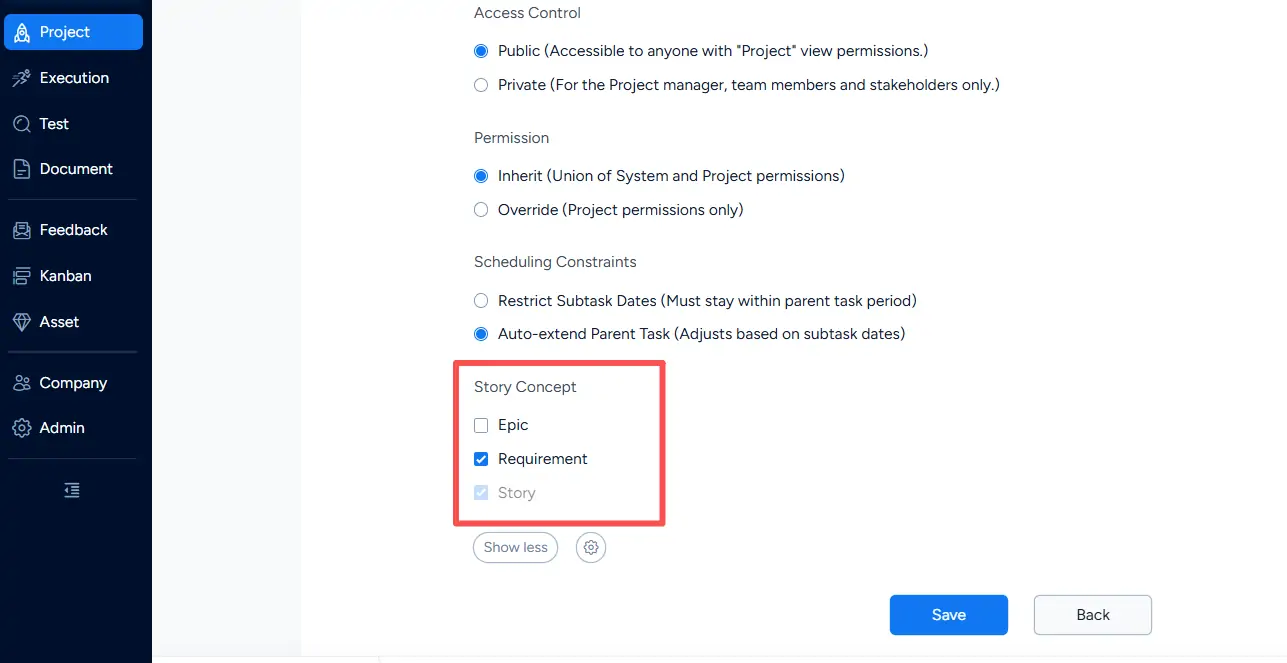
Project settings showing Story Concept options for Epic, Requirement, and Story, with Requirement enabled and Story selected as a mandatory concept.

Within an Execution, open Story to manage the Stories associated with that execution. You can create a Story directly by clicking Create Story, or click Link Story to link an existing Story.

The Execution Story page also provides hierarchy and status filters for locating and managing Story items.

Execution Story page showing hierarchy and status filters, an empty Story list, and the Create Story and Link Story actions available for the execution.

Stories associated with the current Execution are displayed in the Story list. The list provides information such as the Story name, priority, plan, status, creator, and estimate, together with available actions for each Story.

In a Waterfall project, the enabled Story Concept settings determine the hierarchy available at the project level. Within an Execution, the Story page is used to manage the Story items assigned to that execution.
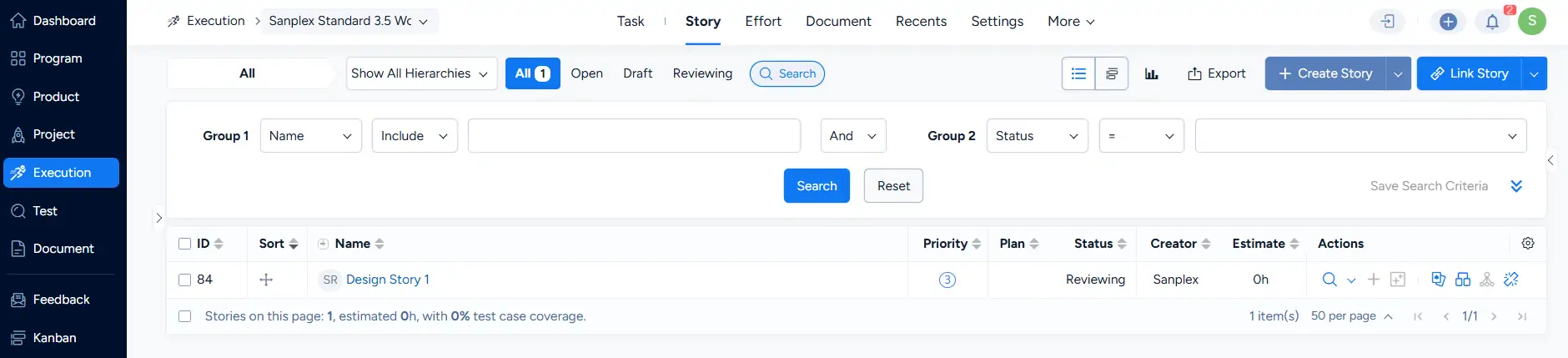
Execution Story list showing a Story in Reviewing status together with its priority, creator, estimate, and available Story management actions.

You can also switch the Execution Story page to Kanban view to track Stories by workflow status.

In the Kanban view, Story cards are organized into status columns such as Initiated, Developing, Dev Completed, Testing, Test Completed, Accepted, and Released. This provides a visual view of Story progress throughout the execution workflow.

Execution Story Kanban showing a Story card under Initiated and workflow columns for Developing, Dev Completed, Testing, Test Completed, Accepted, and Released.

Write a Comment
Comment will be posted after it is reviewed.