
Execution
1. Introduction of Sanplex features
1.1. Core Management Framework
1.1.1 Program
1.1.2 Project
1.1.3 Product
1.1.4 Execution
1.1.5 Management Models
1.2. Dashboard
1.2.1 Getting Started with Tutorials
1.2.2 Quick Add
1.2.3 Notification Center
1.2.4 Effort Tracking
1.2.5 Dashboard - Project and Execution
1.2.6 Dashboard - My Work, Contribution, and Recents
1.2.7 Dashboard - Approval
1.2.8 Contacts
1.3. Program
1.3.1 Program List
1.3.2 Program Kanban
1.3.3 Create Program
1.3.4 Create Sub-Programs
1.3.5 Project Charter Management
1.4. Product
1.4.1 Create Product
1.4.2 Manage Modules
1.4.3 Multi-Branch and Multi-Platform Management
1.4.4 Manage Plans
1.4.5 Manage Requirements
1.4.6 Requirement Reviews
1.4.7 Requirement Status and Phase
1.4.8 Create Releases
1.4.9 Track Progress
1.4.10 Business Requirements and Multi-Level Requirements
1.5. Project
1.5.1 Scrum Project
1.5.2. Waterfall Project
1.5.2.1 Manage Project Phases
1.5.2.2 Project Design
1.5.2.3 Project Matrix
1.5.2.4 Project Reports and Earned Value Management
1.5.2.5 Project Baselines
1.5.2.6 Project Change
1.5.3. Kanban Project
1.5.3.1 Set Up Kanban Projects
1.5.3.2 Configure Kanban Boards
1.5.3.3 Use Kanban Boards
1.5.4 Hybrid Agile Project
1.5.5 Hybrid Waterfall Project
1.5.6. Project Settings
1.5.6.1 Project Setup
1.5.6.2 Project Executions
1.5.6.3 Project Requirements
1.5.6.4 Project Builds
1.5.6.5 Project Tests
1.5.6.6 Project Docs
1.5.6.7 Project Releases
1.5.6.8 Project Reports
1.5.6.9 Project Risks
1.5.6.10 Project Issues
1.5.6.11 Project Opportunities
1.5.6.12 Project Deliverables
1.5.6.13 Project Reviews
1.5.6.14 Project Process
1.5.6.15 Deliverables
1.5.6.16 Project-specific Workflow Management
1.5.7 Project Templates
1.6. Admin Settings
1.7. Workflow

Product Planning and Task Breakdown

2025-12-27 15:50:06
Sanplex Content
427
Last edited by Jing WANG on 2026-09-13 18:53:00
Share links
Summary: Learn how to align on stories during a Product Planning Meeting and convert or break stories down into executable tasks in Sanplex.

After a project or execution is initiated, team members should participate in the Product Planning Meeting and subsequent task breakdown activities to align on the work to be delivered.

Note: “Team members” are not limited to developers. They may also include testers, DBAs, and other roles involved in the project or execution.

1. Product Planning Meeting

During the Product Planning Meeting, the Product Manager walks the team through the stories, including their scope and expected outcomes.

Team members should make sure they understand each story and share feedback so the team reaches a consistent understanding before task breakdown begins.

After the meeting, the Project or Execution Lead can maintain the relevant stories in Sanplex.

On the Story page, click Link Story and select either:

  • Link Story
  • Link Stories by Plan

You can also use Create Story to add a new story when needed.

Execution Story page showing the Link Story menu with Link Story and Link Stories by Plan options.

2. Break Down Tasks

After the Product Planning Meeting, the team can break stories down into executable tasks and estimate the effort required for each task.

Sanplex provides two main ways to create tasks from stories:

  • Batch Convert to Task for converting selected stories into tasks using common task settings.
  • Task creation actions in the Actions column for creating one or multiple tasks for a specific story.

2.1 Batch Convert to Task

On the Story page, select the stories you want to convert.

Open the Edit menu and click Batch Convert to Task.

Story list with multiple stories selected and the Batch Convert to Task option displayed under the Edit menu.

In the Batch Convert to Task dialog, select the Task Type and enter the estimated effort in man-hours.

Under Sync Fields, select the story information to copy to the generated tasks. Available fields shown in the current UI include:

  • Module
  • Description
  • Priority
  • Mail to
  • Assigned to

Only active stories at the lowest hierarchy level can be converted into tasks.

Click Next to continue.
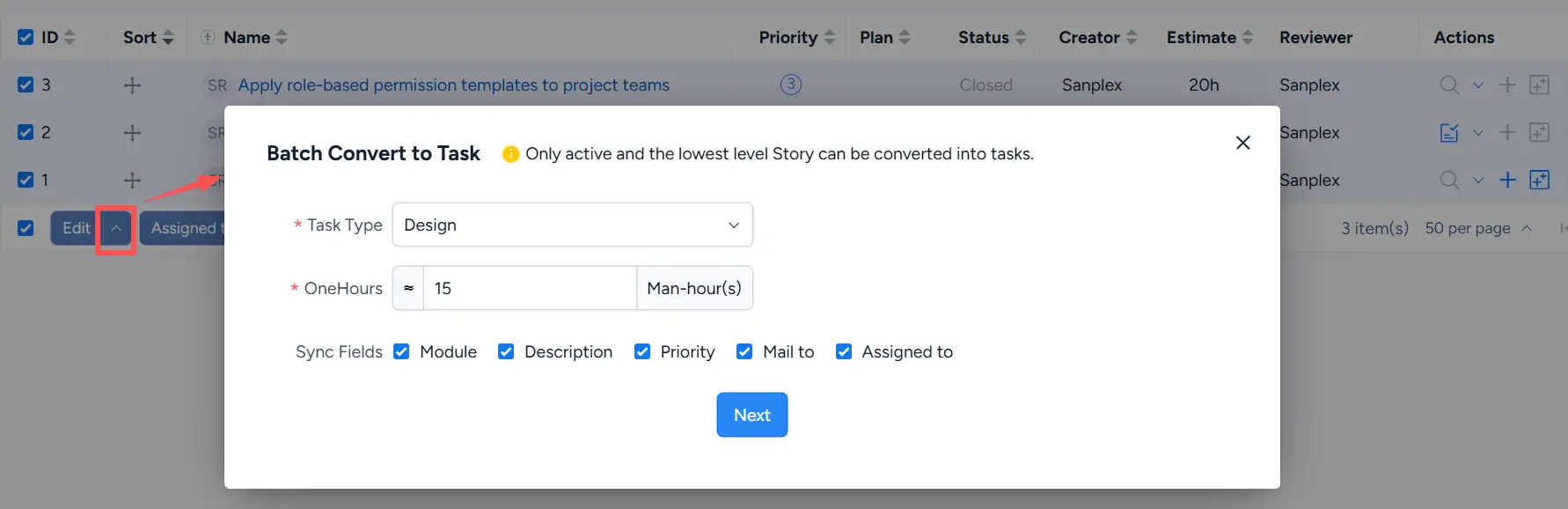
Batch Convert to Task dialog showing Task Type, estimated man-hours, and Sync Fields options for Module, Description, Priority, Mail to, and Assigned to.

On the next page, review the generated task information, including the related story, task name, task type, assignee, estimate, planned start date, due date, and priority.

Click Save to complete the conversion.

Batch Convert to Task page showing the generated task with its module, related story, task name, type, assignee, estimate, planned start, due date, and priority.

2.2 Create Tasks from a Story

In the Actions column of the Story list, use the task-related actions to create tasks for an individual story.

These actions allow a story to be broken down into one or multiple tasks instead of being converted directly into a single task.

Story list showing task-related action icons in the Actions column for creating tasks from individual stories.

When creating multiple tasks, the Batch Create page displays the related story and module for each task row. You can then complete task information, including:

  • Task Name
  • Task Type
  • Assigned to
  • Priority
  • Estimate
  • Planned Start
  • Due Date
  • Description

For supported fields, click Ditto to copy the value from the preceding row, making it faster to enter repeated task information.

You can also use the actions on the right to add or remove task rows as needed.

Click Save after completing the task information.
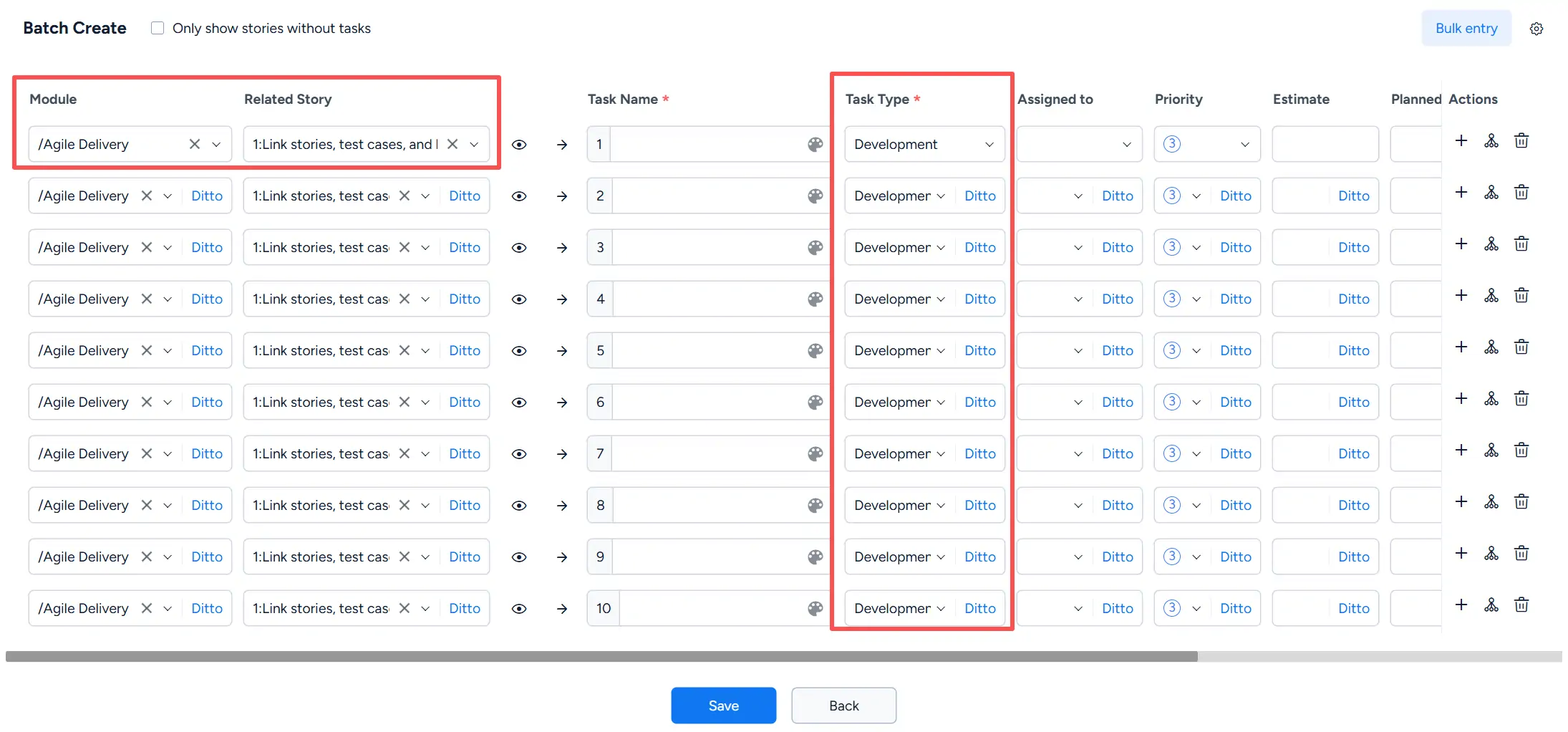
Batch Create page showing multiple task rows with Task Name, Task Type, Assigned to, Priority, Estimate, Planned Start, Due Date, Description, Ditto options, and task row actions.

Tasks created through either method can be managed from the Task page of the project or execution.

Write a Comment
Comment will be posted after it is reviewed.