
Project Settings
1. Introduction of Sanplex features
1.1. Core Management Framework
1.1.1 Program
1.1.2 Project
1.1.3 Product
1.1.4 Execution
1.1.5 Management Models
1.2. Dashboard
1.2.1 Getting Started with Tutorials
1.2.2 Quick Add
1.2.3 Notification Center
1.2.4 Effort Tracking
1.2.5 Dashboard - Project and Execution
1.2.6 Dashboard - My Work, Contribution, and Recents
1.2.7 Dashboard - Approval
1.2.8 Contacts
1.3. Program
1.3.1 Program List
1.3.2 Program Kanban
1.3.3 Create Program
1.3.4 Create Sub-Programs
1.3.5 Project Charter Management
1.4. Product
1.4.1 Create Product
1.4.2 Manage Modules
1.4.3 Multi-Branch and Multi-Platform Management
1.4.4 Manage Plans
1.4.5 Manage Requirements
1.4.6 Requirement Reviews
1.4.7 Requirement Status and Phase
1.4.8 Create Releases
1.4.9 Track Progress
1.4.10 Business Requirements and Multi-Level Requirements
1.5. Project
1.5.1 Scrum Project
1.5.2. Waterfall Project
1.5.2.1 Manage Project Phases
1.5.2.2 Project Design
1.5.2.3 Project Matrix
1.5.2.4 Project Reports and Earned Value Management
1.5.2.5 Project Baselines
1.5.2.6 Project Change
1.5.3. Kanban Project
1.5.3.1 Set Up Kanban Projects
1.5.3.2 Configure Kanban Boards
1.5.3.3 Use Kanban Boards
1.5.4 Hybrid Agile Project
1.5.5 Hybrid Waterfall Project
1.5.6. Project Settings
1.5.6.1 Project Setup
1.5.6.2 Project Executions
1.5.6.3 Project Requirements
1.5.6.4 Project Builds
1.5.6.5 Project Tests
1.5.6.6 Project Docs
1.5.6.7 Project Releases
1.5.6.8 Project Reports
1.5.6.9 Project Issues
1.5.6.10 Project Opportunities
1.6. Admin Settings
1.7. Workflow

Project Issues

2026-03-28 20:57:21
Sanplex Content
111
Last edited by Jing WANG on 2026-09-03 19:37:20
Share links
Summary: Learn how to create project issues, set issue types and severity, assign and track issues, manage issue status, and import reusable issues to the library.

Feature Overview

The Project Issues feature helps teams identify, log, assign, track, and resolve issues that have already occurred, supporting structured issue management and follow-up throughout project delivery.

By reviewing issues over time, teams can capture lessons learned, improve future issue handling, and support better project delivery and execution.

Use Cases

  • Issue logging and assignment: During project execution, teams can log issues as they arise and assign them to the appropriate team members for follow-up.
  • Issue prioritization: Teams can set severity and priority levels to identify issues that require greater attention.
  • Cross-team collaboration: Project members can track issue status and ownership to stay aligned on progress and follow-up actions.
  • Issue lifecycle management: Teams can manage issues from creation through confirmation, assignment, resolution, cancellation, or closure.
  • Knowledge reuse: Representative issues can be imported to the library for future reference and reuse.

An issue represents a project-related problem that has already occurred and can be tracked separately within the project.

Sanplex provides multiple issue types, including Design, Code, Performance, Version, New Story, Story Change, Story Deleted, and Data.

1. Create an Issue

Go to Project > Select a Project > Issue, then click Create Issue.

Project Issue page showing status filters, search, import and export options, and the Create Issue button in the upper-right corner for adding a new project issue.

On the Create Issue page, enter the Issue Name, select a Type, and complete the applicable issue information.

The page also provides fields for Project, Severity, Priority, Assigned to, Reporter, Deadline, Description, and file attachments.
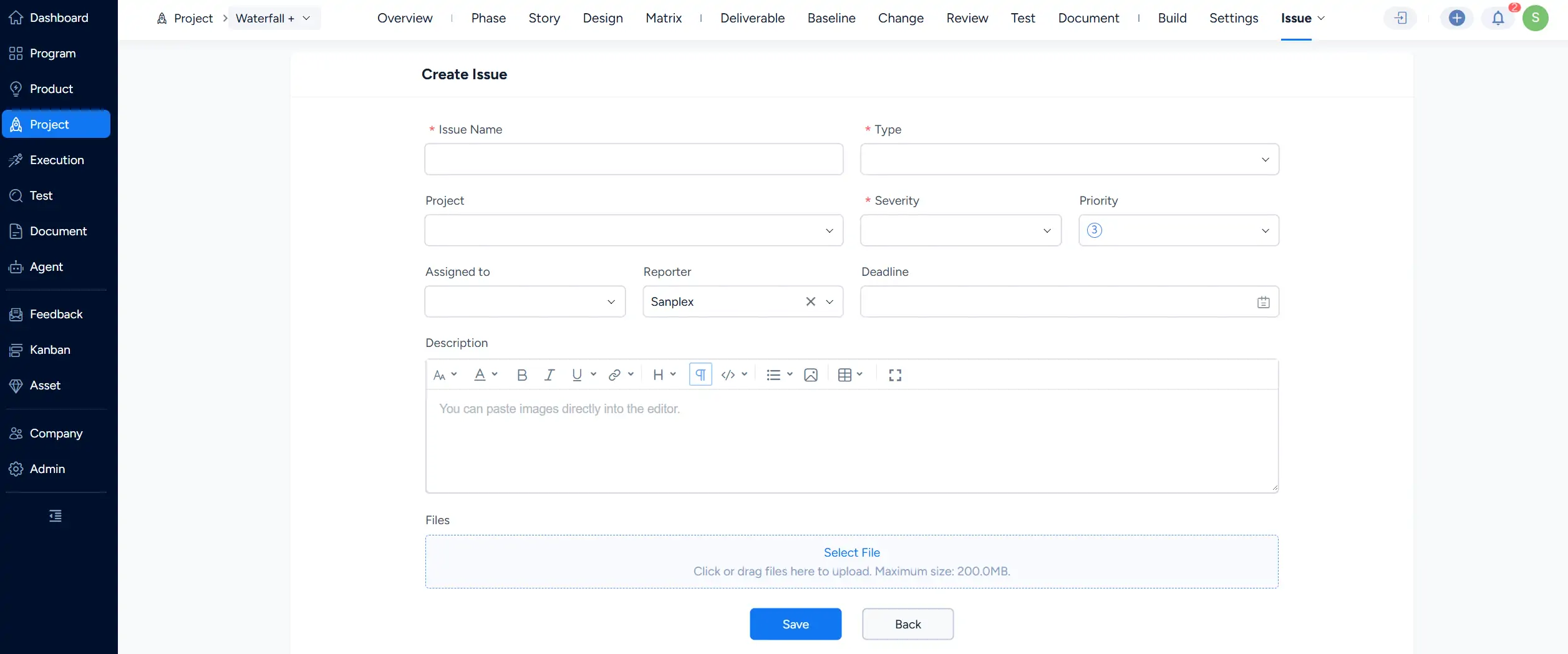
Create Issue form showing fields for Issue Name, Type, Project, Severity, Priority, assignee, reporter, deadline, description, and file attachments, with Save and Back buttons.

Click Save to create the issue. The issue then appears on the project Issue list.

2. Manage Issues

The Issue list provides status-based filters such as All, Active, Assigned to Me, Assigned by Me, Closed, Resolved, and Cancelled.

The list displays key information including the issue name, priority, severity, reporter, created date, assignee, and result. Use the icons in the Actions column to perform available actions on an issue.

Project Issue list showing four issues with priority, severity, reporter, created date, assignee, result, and multiple action icons for managing each issue.

Click an issue name to open its details page.

The details page displays the issue description, history, basic information, and linked objects. The action bar provides controls including Confirm, Assign, Effort, Cancel, Closed, Import To Lib, Edit, and Delete, depending on the current issue state.

Use Import To Lib to save a representative issue to the library for future reference and reuse.
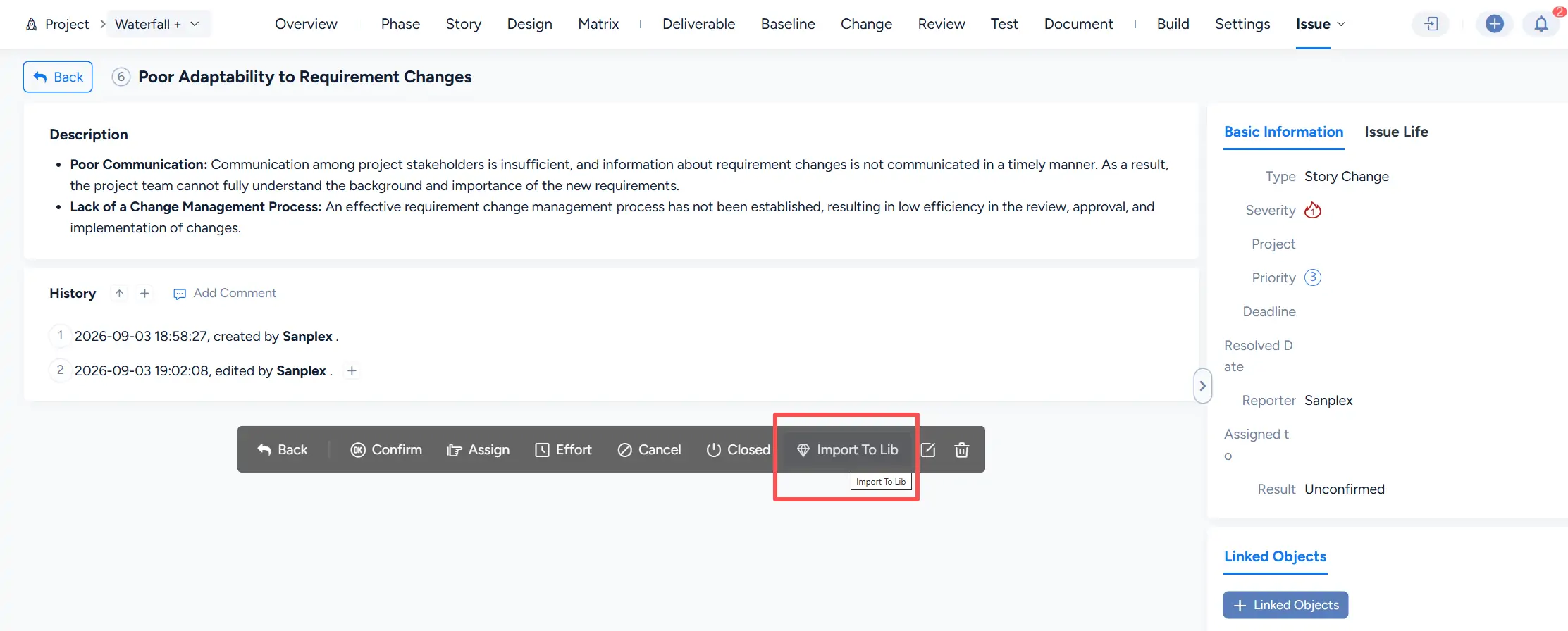
Issue details page showing the issue description, history, basic information, linked objects, and the action toolbar with Confirm, Assign, Effort, Cancel, Closed, and Import To Lib actions.

Write a Comment
Comment will be posted after it is reviewed.