
Execution
1. Introduction of Sanplex features
1.1. Core Management Framework
1.1.1 Program
1.1.2 Project
1.1.3 Product
1.1.4 Execution
1.1.5 Management Models
1.2. Dashboard
1.2.1 Getting Started with Tutorials
1.2.2 Quick Add
1.2.3 Notification Center
1.2.4 Effort Tracking
1.2.5 Dashboard - Project and Execution
1.2.6 Dashboard - My Work, Contribution, and Recents
1.2.7 Dashboard - Approval
1.2.8 Contacts
1.3. Program
1.3.1 Program List
1.3.2 Program Kanban
1.3.3 Create Program
1.3.4 Create Sub-Programs
1.3.5 Project Charter Management
1.4. Product
1.4.1 Create Product
1.4.2 Manage Modules
1.4.3 Multi-Branch and Multi-Platform Management
1.4.4 Manage Plans
1.4.5 Manage Requirements
1.4.6 Requirement Reviews
1.4.7 Requirement Status and Phase
1.4.8 Create Releases
1.4.9 Track Progress
1.4.10 Business Requirements and Multi-Level Requirements
1.5. Project
1.5.1 Scrum Project
1.5.2. Waterfall Project
1.5.2.1 Manage Project Phases
1.5.2.2 Project Design
1.5.2.3 Project Matrix
1.5.2.4 Project Reports and Earned Value Management
1.5.2.5 Project Baselines
1.5.2.6 Project Change
1.5.3. Kanban Project
1.5.3.1 Set Up Kanban Projects
1.5.3.2 Configure Kanban Boards
1.5.3.3 Use Kanban Boards
1.5.4 Hybrid Agile Project
1.5.5 Hybrid Waterfall Project
1.5.6. Project Settings
1.5.6.1 Project Setup
1.5.6.2 Project Executions
1.5.6.3 Project Requirements
1.5.6.4 Project Builds
1.5.6.5 Project Tests
1.5.6.6 Project Docs
1.5.6.7 Project Releases
1.5.6.8 Project Reports
1.5.6.9 Project Risks
1.5.6.10 Project Issues
1.5.6.11 Project Opportunities
1.5.6.12 Project Deliverables
1.5.6.13 Project Reviews
1.5.6.14 Project Process
1.5.6.15 Deliverables
1.5.6.16 Quality Assurance
1.5.6.17 Project-specific Workflow Management
1.5.7 Project Templates
1.6. Execution
1.6.1 Product Planning and Task Breakdown
1.6.2 Task Assignment and Daily Tracking
1.6.3 Build Creation and Test Requests
1.6.4 Bug Confirmation and Resolution
1.7. Admin Settings
1.8. Workflow

Bug Confirmation and Resolution

2025-12-27 15:51:44
Sanplex Content
402
Last edited by Jing WANG on 2026-09-20 16:53:03
Share links
Summary: Learn how to confirm and resolve bugs in Sanplex, select the appropriate resolution, and convert a bug to a Story when follow-up work needs to continue through the Story workflow.

After bugs are reported during testing, developers are responsible for confirming and resolving the bugs assigned to them.

A typical bug-handling workflow is:

Tester reports a bug → Developer confirms and resolves the bug → Tester verifies the fix and closes the bug

If verification fails, the bug can be reactivated for further investigation and resolution.

Developers should review assigned bugs promptly and record the appropriate resolution information in Sanplex.

I. Confirm Bugs

After a tester reports a bug, the developer can Confirm it to acknowledge the issue before resolving it.

The bug list shows whether each bug has been confirmed. You can confirm a bug directly from the Test > Bug list by clicking Confirm in the Actions column.

The Sanplex Test > Bug list showing the Confirm actions in the Actions column for open bugs.

You can also open the bug details page and click Confirm in the action bar.

Once a bug is resolved, it is also treated as confirmed.

II. Resolve Bugs

To resolve a bug, click Resolve in the Actions column of the Test > Bug list.

The Sanplex Bug list showing the Resolve action for open bugs in the Actions column.

You can also open the bug details page and click Resolve in the action bar.
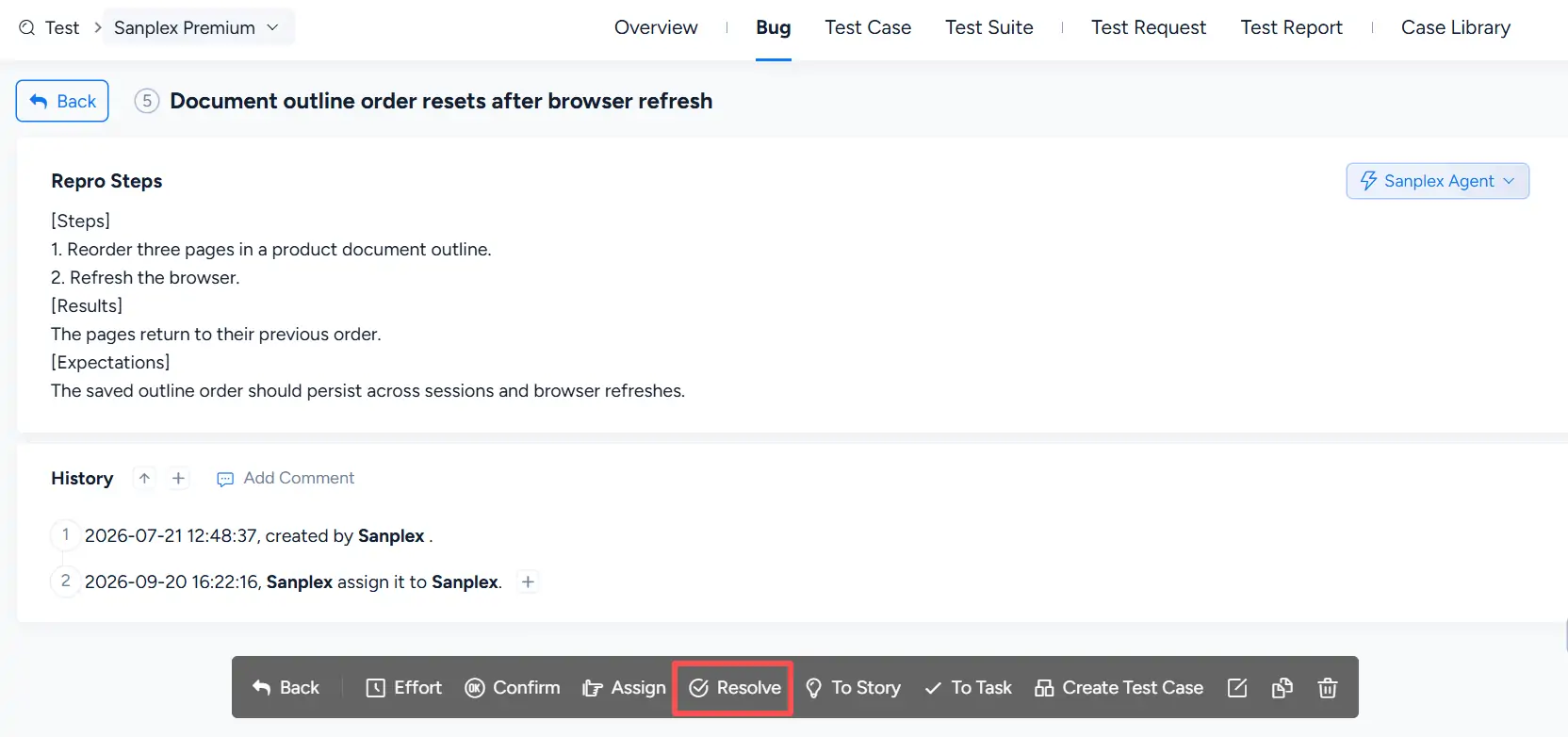
A Sanplex bug details page showing the Resolve action in the bottom action bar.

In the Resolve Bug dialog, select a Resolution and complete the relevant resolution information, such as Fixed Build, Resolved on, Assigned to, files, and notes.
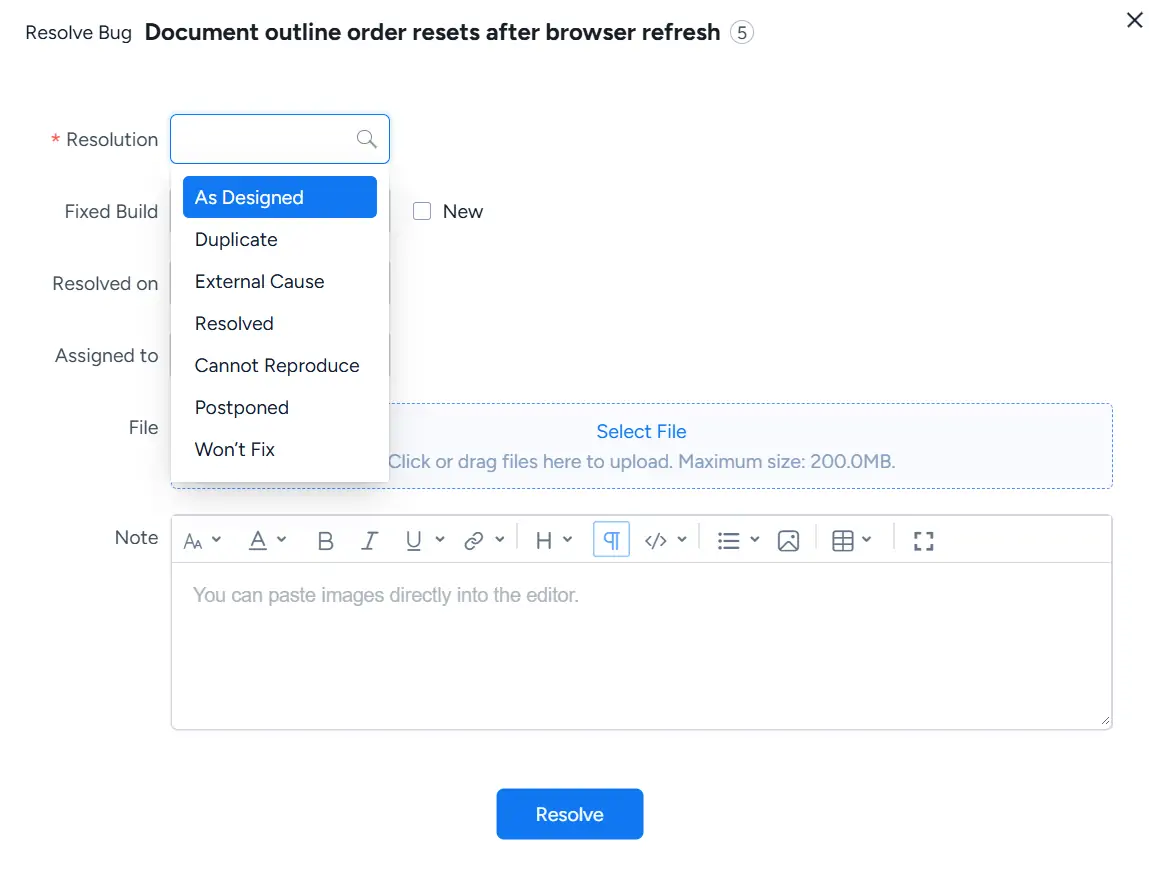
The Resolve Bug dialog showing the Resolution dropdown with As Designed, Duplicate, External Cause, Resolved, Cannot Reproduce, Postponed, and Won’t Fix.

After the resolution is submitted, Sanplex records the resolution information for subsequent verification and tracking.

III. Bug Resolution Options

1. Built-in Resolution Options

Sanplex provides the following built-in resolution options:

  • As Designed: the behavior works as designed and no change is required.
  • Duplicate: the same issue has already been reported in another bug.
  • External Cause: the issue is caused by an external factor.
  • Resolved: the issue has been resolved.
  • Cannot Reproduce: the reported issue cannot be reproduced.
  • Postponed: the issue is valid, but its resolution is deferred.
  • Won’t Fix: the issue will not be fixed.

Select the resolution that best reflects how the bug has been handled.

2. Convert a Bug to a Story

Converting a bug to a Story is handled separately from bug resolution.

On the bug details page, click To Story in the action bar.
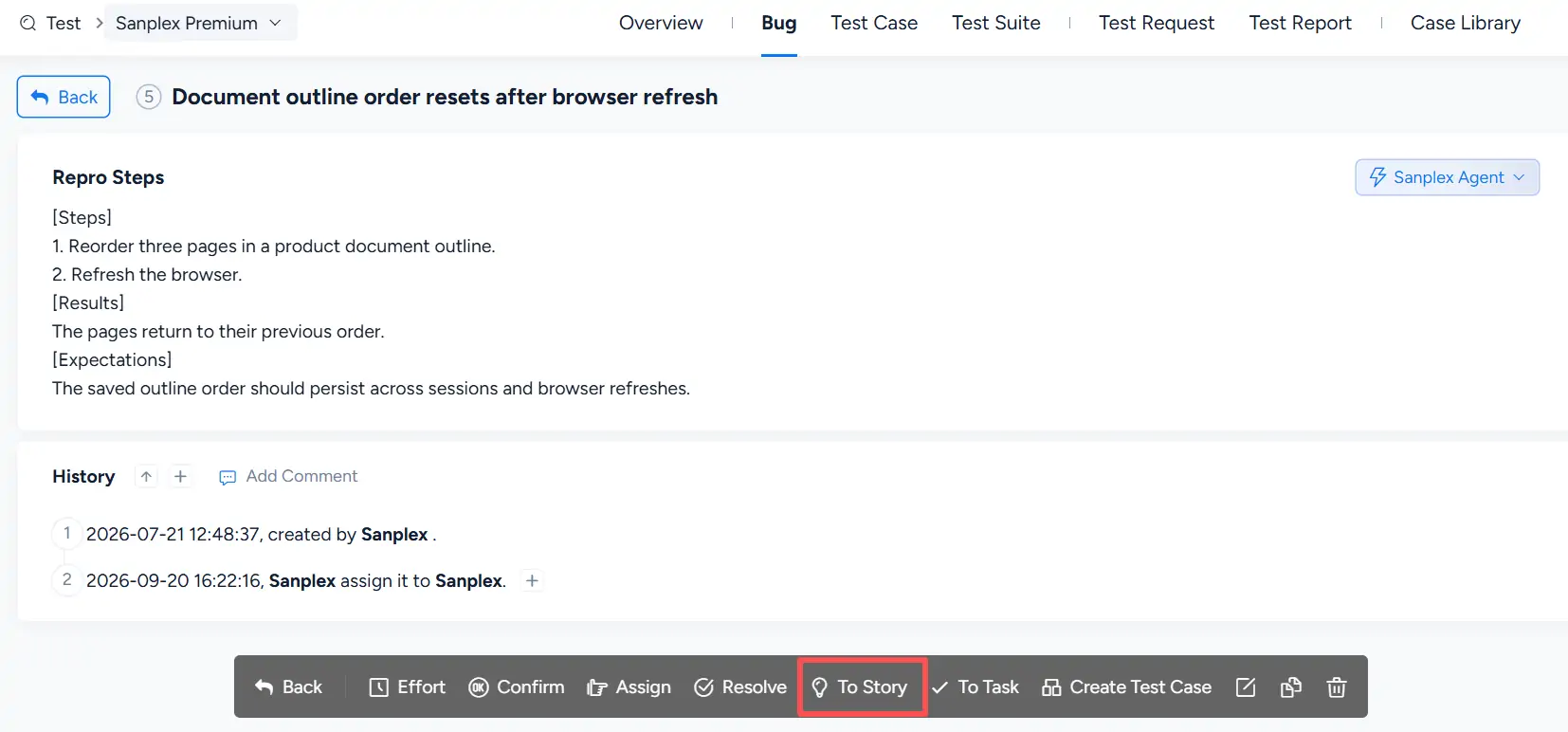
A Sanplex bug details page showing the To Story action in the bottom action bar.

After conversion, the generated Story records its relationship to the original bug in History. For example, the history can show that the Story was converted from a specific Bug ID.
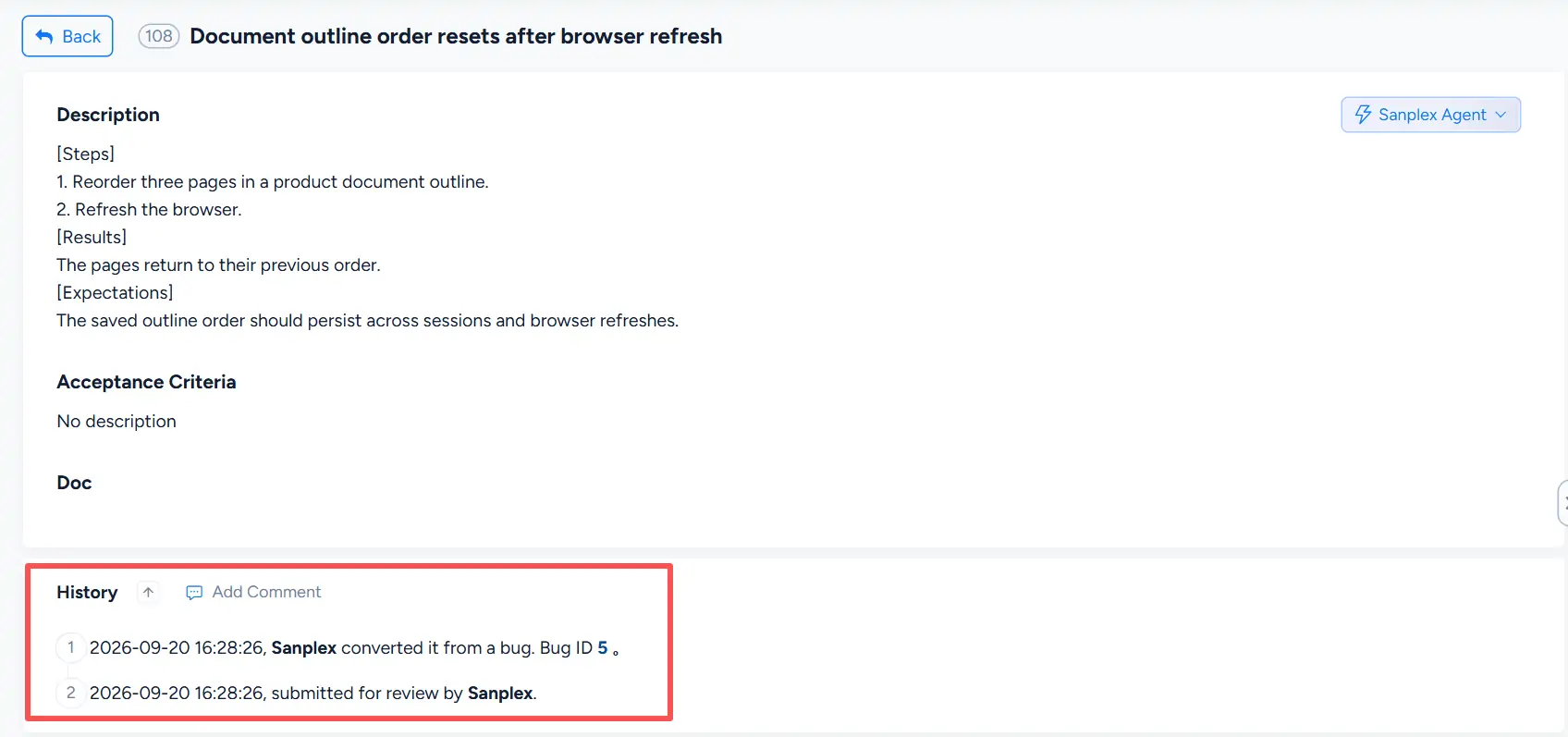
A Sanplex Story details page showing History entries indicating that the Story was converted from Bug ID 5 and submitted for review.

This keeps the original bug and the resulting Story traceable within Sanplex.

Write a Comment
Comment will be posted after it is reviewed.